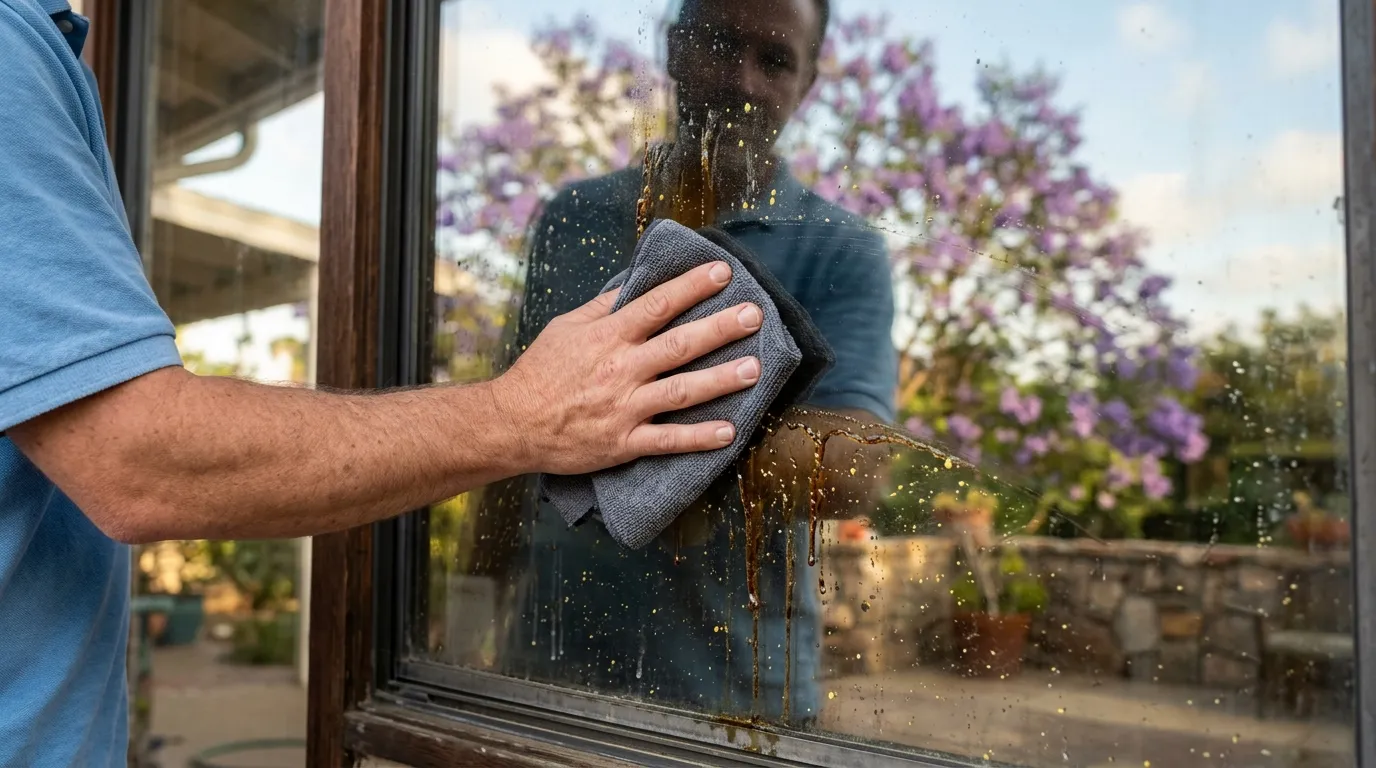
Tree sap comes off glass with isopropyl alcohol on a soft cloth, worked in small circles. Bird droppings need to be softened first with warm water before you wipe, never scraped dry. Pollen rinses off with a gentle soapy wash, but if it’s baked on through a dry San Diego spring, a second pass with dish soap and a microfiber cloth usually does it.
San Diego’s urban canopy throws a particular mix at your windows. Jacaranda, pine, and eucalyptus are the main sap culprits. Pigeons, crows, and ravens leave droppings that are mildly acidic and can etch glass if you ignore them long enough. Knowing which stain you’re dealing with changes the cleaning method, and using the wrong one risks scratching or permanently dulling the pane.
Tree sap: jacaranda, pine, and eucalyptus
Jacaranda trees are everywhere in San Diego, from Balboa Park to residential streets in North Park, Hillcrest, and Bankers Hill. They bloom in late spring and drop sticky purple flowers and sap that land on anything underneath, including windows, glass table tops, and car paint. Pine sap shows up in neighborhoods near Los Penasquitos Canyon, Black Mountain, and the inland foothills. Eucalyptus is one of the most common street trees in the county and leaves a sticky, resinous residue on glass below it.
Fresh sap is easier to remove than cured sap. The goal is to dissolve the resin without scratching the glass surface.
What works: Dampen a microfiber cloth with 70 percent isopropyl alcohol. Press the cloth against the sap spot and hold it for 20 to 30 seconds to let the alcohol penetrate. Then wipe in gentle circular motions. Don’t scrub aggressively on the first pass. Repeat the hold-and-wipe until the spot lifts.
What to avoid: Razor blades on dry glass, abrasive scrubbers, and acetone-based products. Acetone can damage window seals and tinting. A razor at the wrong angle on a dry pane leaves fine scratches that catch light and are permanent.
For larger sap patches or older cured sap that’s been baked on through a few warm weeks, a commercial citrus-based adhesive remover works better than isopropyl alone. Apply it the same way: soak, wait, wipe gently. If you’re dealing with a lot of sap and want to be sure the glass comes through undamaged, our hard-water removal service includes treatment for bonded organic residue.
Bird droppings: act fast, don’t scrape dry
Bird droppings are mildly acidic and contain uric acid. On glass, that acidity isn’t usually a problem if you clean within a day or two. Let droppings bake in San Diego sun for a week or more, and the acid can etch a shallow mark into the glass surface that won’t wipe away.
The right method: Soak a folded paper towel or microfiber cloth in warm water and lay it directly over the droppings for two to three minutes. This softens them without any scraping force. Then wipe gently from the outside of the dropping inward. Follow with a standard glass cleaner or soapy water rinse.
What not to do: Don’t scrape dry droppings with a fingernail, a plastic scraper, or anything abrasive. Dried bird waste has gritty particles in it that scratch glass as you drag it. The softening step is what makes this safe.
If droppings have been sitting through multiple wet-and-dry cycles and the glass shows a frosted haze where they were, that’s etching. Light etching sometimes responds to a polishing compound made for glass. Deeper etching is permanent, or close to it. That’s when a professional assessment is worth it before you spend money on cleaning that won’t change the result. Our residential window cleaning team sees this regularly on homes under large trees.
Pollen: the San Diego spring problem
San Diego’s pollen season runs roughly from February through June, with the peak load hitting in March and April. Eucalyptus, acacia, and various flowering ornamental trees put a yellow-green film on everything during those months, including south and west-facing glass that catches the afternoon breeze.
Fresh pollen is easy. A garden hose on a gentle setting rinses most of it off without any scrubbing. If you follow with a light soapy wash and a rinse, the glass comes clean.
Baked-on pollen is a different problem. When pollen lands on warm glass and stays through a dry stretch, it starts to bond. Morning marine layer wets it, afternoon sun dries it, and after a few cycles the pollen film is bonded to the glass surface like a light mineral deposit.
For baked pollen: fill a bucket with warm water and a few drops of dish soap. Work in small sections with a clean microfiber cloth, using light circular pressure. Rinse each section before moving on. Don’t let the soapy water dry on the glass or you’ll swap a pollen haze for a soap haze.
If you want a streak-free finish after removing pollen, our streak-free window cleaning guide covers the specific wipe technique and water type that prevents leftover film.
Jacaranda flower stains
Jacaranda gets its own section because it leaves two problems instead of one. The purple flowers drop and leave a water-soluble dye when they’re fresh and a sticky resin residue when they’ve been sitting. The timing matters.
If flowers have just landed on a damp or dewy window, a soapy water rinse usually handles the dye before it sets. If flowers have dried on the glass and stuck, treat the sticky residue with isopropyl alcohol the same way you’d treat sap. The dried flower creates a brownish-purple stain around the point of contact that a standard glass cleaner won’t touch.
Jacaranda season in San Diego runs from late April through June. If you live on a street with mature jacaranda canopy, a quick spray-and-wipe every few days during peak bloom keeps the staining manageable. Letting it build for a month means more work and a higher chance of staining the sill and frame as well as the glass.
When the damage is already done
Some organic stains leave permanent marks. Tree sap that’s been on double-pane glass for months can degrade the coating on low-e glass. Bird dropping etching that went unnoticed through a summer looks like a frosted spot that doesn’t wipe off. Pollen that bonded into existing hard-water deposits becomes part of the mineral layer.
Before you assume permanent damage, try a glass polishing compound designed for light etching. Apply it with a microfiber applicator pad, work in small circles with light pressure, and buff off with a clean cloth. This can reduce the appearance of shallow etching.
Moderate etching that doesn’t respond to polishing sometimes responds to a professional diamond-pad restoration process. Deep etching and coating damage are generally permanent. If you’ve got spots you can’t clean and aren’t sure whether they’re salvageable, it’s worth getting an honest assessment before replacing glass. We cover the full etching picture in our guide on hard-water spots on San Diego windows, since mineral etching and organic etching often show up together.
For anything sticky that’s more adhesive than resin, our post on removing sticky residue and adhesive from glass covers tape, decal, and label removal, which uses similar solvents but a different sequence.
What a pro handles differently
A professional window cleaner brings a few things that make organic stain removal faster and lower-risk.
The first is access. Upper-floor windows and windows with tight trim or fragile frames are harder to treat safely without the right ladder setup and squeegee technique. Most DIY sap removal problems happen on upper windows because the reach leads to awkward angles and harder pressure than the glass needs.
The second is the right products. Commercial citrus solvents, professional-grade glass polishing compounds, and two-bucket rinse systems aren’t always easy to source, and the wrong solvent on a coated window causes more damage than the original stain.
The third is the follow-through. After removing organic stains, a proper squeegee pass removes all solvent and soap residue in a single stroke, and the glass comes out cleaner than it went in, not just stain-free. Our screen cleaning service also handles the screens around those windows, since pollen and sap residue transfers to mesh and blocks the view even after the glass is clean.
If you’ve got sap, droppings, or baked pollen across multiple windows and want it handled right, call us at (858) 925-5546. We cover all of San Diego County. For a full picture of what we handle, the San Diego window cleaning service hub has the complete scope.
FAQ
How do you remove tree sap from windows without scratching the glass?
Soak a microfiber cloth with 70 percent isopropyl alcohol, press it against the sap for 20 to 30 seconds, then wipe gently in small circles. The hold time is what matters. Wiping without softening first drags the resin across the glass and scratches it. For cured or thick sap, a citrus-based adhesive remover works better than isopropyl alone.
Can bird droppings permanently damage windows?
Yes, if left long enough. Bird droppings contain uric acid, and in San Diego sun they bake onto the glass within a few days. Left for a week or more, the acid can etch a shallow, frosted mark into the glass surface. It won’t wipe away. The fix is removing droppings quickly by softening them with warm water first, never scraping dry.
Why does jacaranda stain windows differently than regular sap?
Jacaranda drops both flowers and sap. Fresh flowers leave a water-soluble dye that rinses off easily. Dried flowers stick and leave a brownish-purple stain from the resin. Treat the sticky residue with isopropyl alcohol the same way you’d treat pine or eucalyptus sap. During jacaranda season in April through June, a quick rinse every few days prevents stain buildup.
How do you remove baked-on pollen from glass?
Warm soapy water and a microfiber cloth, working in small sections with light circular pressure, handles most baked pollen. The key is rinsing each section before the soapy water dries, or you’ll leave a soap film instead of a pollen film. If pollen has bonded into a hard-water deposit layer, it needs the same treatment as mineral spotting.
What does tree sap etching look like and is it fixable?
Tree sap etching looks like a slightly frosted or matte area on otherwise clear glass, usually circular where the sap sat. On standard glass, light etching sometimes responds to a glass polishing compound. On coated glass, like low-e double-pane windows, prolonged sap contact can degrade the coating in a way that isn’t reversible. Getting sap off quickly prevents this.
When should I call a professional instead of cleaning organic stains myself?
Call a pro when the glass shows frosted spots that don’t wipe clean, when sap has been on the glass for more than a few weeks, when droppings have left etched marks, or when the windows are on upper floors where safe reach requires proper ladder setup. A professional can also tell you honestly whether a stain is removable or whether the damage is permanent before you spend time on cleaning that won’t change the outcome.