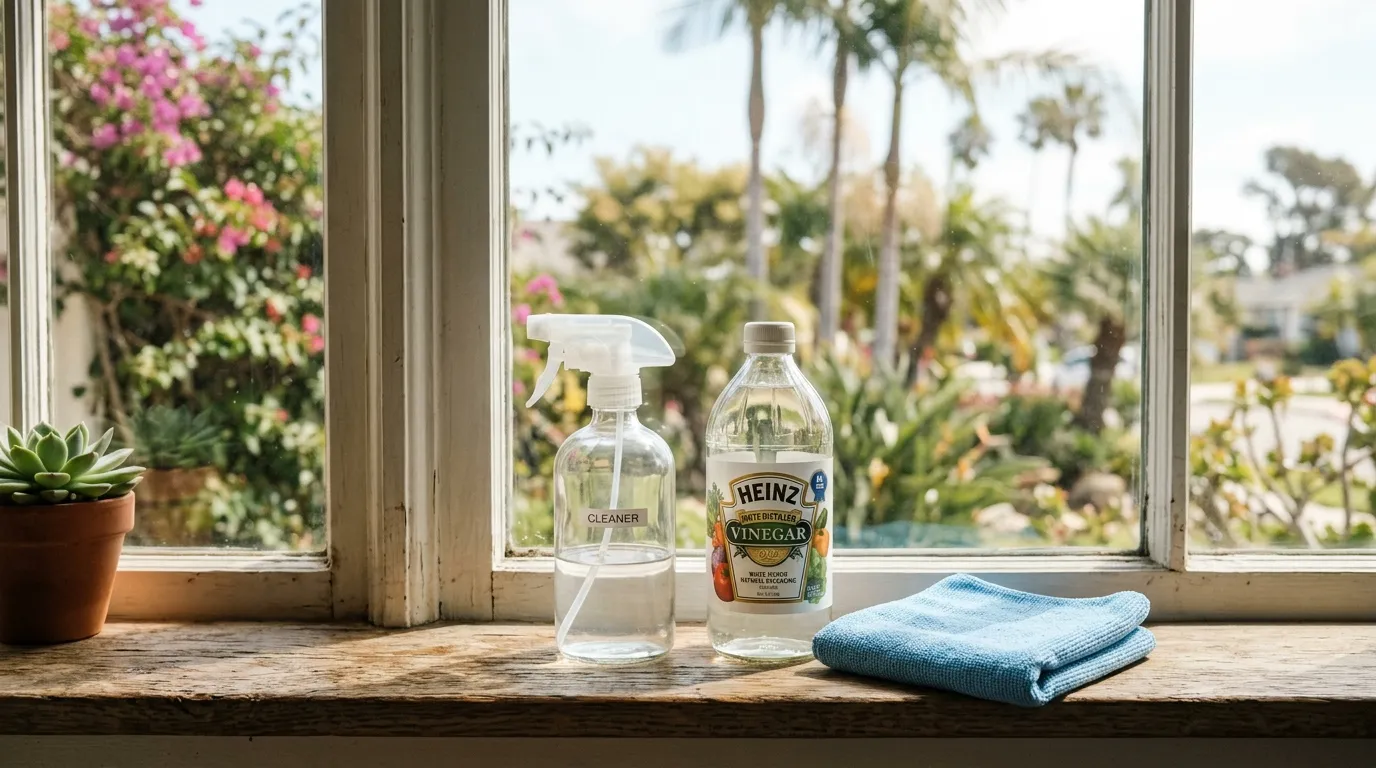
Vinegar does clean windows. A 50/50 mix of white distilled vinegar and water cuts grease, light dust film, and mild mineral haze well enough to see the difference. Where it falls short is the tougher stuff: bonded hard-water mineral spots, salt-crusted glass on coastal homes, or anything that’s been baking on for months. In San Diego those tougher conditions are common, so vinegar is a useful starting tool, but not always a finishing one.
Here’s the full picture: how it works, the ratio, what it genuinely handles, what it doesn’t, and when the glass in your specific San Diego home might need something more.
The vinegar and water ratio that actually works
The most reliable ratio for cleaning windows with vinegar is one part white distilled vinegar to one part warm water. That’s a 50/50 mix.
Some guides push a higher vinegar concentration. It doesn’t meaningfully improve cleaning power on glass. The acetic acid in standard five-percent distilled white vinegar is already doing the work at half strength. Going stronger mainly means the smell lingers longer.
Mix it in a clean spray bottle. Use warm water, not hot. Hot water on cool glass can stress the pane and sometimes causes vinegar to evaporate before it does much. Shake lightly before each application.
One important addition: a few drops of dish soap in the bottle helps the solution cling to vertical glass long enough to do its job. Without a surfactant, vinegar solution runs straight down the pane before it breaks up the film. A small drop of soap is enough. More than that and you’re creating new streaks.
Why vinegar works on glass
White vinegar is mildly acidic, with a pH around two to three. That acidity does two things on glass.
First, it cuts through grease and oily film. Fingerprints near handles, smears from cleaning sprays that weren’t wiped clean, and the general greasy haze that builds up on interior glass all respond well to acid. Soap-based cleaners work here too, but they leave their own residue if not fully rinsed.
Second, dilute acid dissolves light mineral deposits. San Diego’s tap water contains calcium and magnesium. When water dries on glass, those minerals stay behind. A light layer of this, the kind you get from a single season of sprinkler overspray or a few months of not cleaning, will respond to vinegar. The acid reacts with the mineral compounds and breaks them loose.
What this means in practice: for everyday grime and light mineral haze, vinegar is a legitimate cleaner. The glass comes out cleaner than it was, and with a proper squeegee, it comes out streak-free.
Why you get streaks without a squeegee
Most vinegar streaks come from technique, not the vinegar. Wiping glass dry with paper towels or even microfiber cloths leaves lint, redistributes dissolved film, and drags residue into uneven lines. The liquid doesn’t come off evenly when you wipe it.
A squeegee solves this. It removes liquid in a single controlled pass rather than spreading it. The process is: spray the glass, work in a small section, pull the squeegee top to bottom in overlapping strokes, and wipe the blade dry between passes. That last step matters. A wet squeegee blade just pushes the solution around.
Good technique with a squeegee and a vinegar solution produces genuinely streak-free glass. Poor technique with any product produces streaks. The tool is more important than the cleaner. Our post on how to clean windows streak-free covers this in more detail if you want the full method.
What vinegar does not handle
This is where San Diego-specific context matters.
Etched hard-water mineral spots. San Diego’s water supply is relatively hard, running around 16 to 18 grains per gallon depending on the source water in your part of the county. When hard water dries repeatedly on glass, the minerals don’t just sit on top, they bond chemically into the glass surface. That’s called etching. Etched mineral spots are not a film you can dissolve with dilute acid. They require a polishing compound or professional hard-water removal process, not more vinegar.
Coastal salt buildup. Homes within a mile or two of the ocean in La Jolla, Pacific Beach, Del Mar, Encinitas, Carlsbad, Coronado, or Oceanside deal with salt-laden marine air. Salt film is a different chemistry than mineral film. It can respond to vinegar when it’s light and fresh, but a thick or long-standing salt layer, especially one that’s been wet and re-dried repeatedly by the marine layer, can be stubborn. Our post on coastal salt haze on San Diego windows covers what’s actually happening to coastal glass and what it takes to address it.
Heavy oxidation or sun damage. South-facing and west-facing glass in San Diego takes significant UV and heat exposure. Over time this can cloud the glass itself. Cleaning solutions, vinegar or otherwise, don’t reverse that. It’s structural damage to the glass.
Paint overspray, adhesive residue, construction debris. Vinegar won’t touch these. They need physical removal, not chemistry.
San Diego’s hard water reality
San Diego imports most of its water from the Colorado River and the State Water Project. Both sources carry significant mineral content. That mineral content ends up on every surface water touches, and glass is particularly revealing because it’s smooth and transparent.
The result is that light mineral haze is a near-constant condition on San Diego glass, especially on windows near irrigation systems. Vinegar handles the early stages of this well. If you clean regularly and catch the buildup before it bonds, a vinegar solution is a reasonable maintenance cleaner.
The problem is when mineral spots sit for months, bake in the sun, and get repeatedly wet by sprinkler overspray or marine layer moisture. At that point the mineral content has etched into the glass surface. Vinegar won’t fix it. Scrubbing harder won’t fix it. The best approach is professional treatment with a mild polishing compound followed by a water-repellent coating that slows re-spotting. For a deeper look at spot types and when each needs professional attention, our post on hard-water spots on San Diego windows has the full breakdown.
When to use vinegar and when to call someone
Vinegar makes sense as a regular maintenance cleaner when your glass is in generally good shape. Interior windows, recently cleaned glass that’s picked up light dust and finger grease, and windows away from irrigation systems or coastal air are the best candidates.
Vinegar is the wrong tool when there are visible white or cloudy mineral spots that don’t wipe away, when the glass has a hazy look that doesn’t improve after cleaning, when coastal glass hasn’t been treated in over a year, or when you’re seeing pitting or roughness when you run a fingernail across the glass surface.
For those cases, standard DIY solutions, including commercial glass cleaners, won’t produce a clean result either. Our residential window cleaning service handles both routine maintenance cleaning and the harder mineral and salt removal work. If you’re not sure which category your glass is in, it’s worth calling (858) 925-5546 before spending a morning on something that needs a different approach.
We also cover how vinegar compares to commercial glass cleaners in our post on the best glass cleaner for windows, if you want to see where it lands in the full lineup.
For a full overview of window cleaning services across San Diego County, the San Diego window cleaning service hub covers what’s available by service type and area.
FAQ
Does cleaning windows with vinegar actually work?
Yes, for light film, grease, and mild mineral haze, a 50/50 vinegar and water solution cleans glass effectively. The acetic acid breaks down oily residue and dissolves light mineral deposits. It does not work on etched hard-water spots, heavy salt buildup, or sun-damaged glass.
What is the best vinegar ratio for cleaning windows?
One part white distilled vinegar to one part warm water, with a few drops of dish soap added. The soap acts as a surfactant that helps the solution cling to vertical glass instead of running off immediately. A stronger vinegar concentration does not meaningfully improve results and mainly adds smell.
Why are my windows still streaky after using vinegar?
The streaks are almost always from wiping technique, not the vinegar. Cloth wiping redistributes dissolved film unevenly. Use a squeegee, pull top to bottom in overlapping passes, and wipe the blade dry between each pass. This removes liquid instead of moving it around.
Can vinegar remove hard-water spots from San Diego windows?
Light, fresh mineral haze, yes. Etched mineral spots that have bonded into the glass over months of repeated wetting and drying, no. San Diego’s hard water causes etching faster than many other regions because the mineral content is high and the sun accelerates the bonding process. Etched spots require polishing, not dissolving.
Is vinegar safe for all window types?
It is safe for standard tempered and annealed glass. Avoid it on tinted window films, as repeated acid exposure can affect the adhesive layer over time. Also avoid applying it to window frames with an untreated finish, since the acid can affect some painted or coated surfaces. Spray onto the glass surface directly rather than onto frames.
How often should I clean my San Diego windows with vinegar?
For interior glass in good condition, every few months is reasonable as a maintenance clean. For exterior glass in San Diego, especially near irrigation or the coast, vinegar maintenance only delays the need for professional treatment, it does not replace it. Most San Diego homes do best with professional exterior cleaning two to four times per year, depending on how close they are to the ocean and how much sprinkler overspray the glass sees.