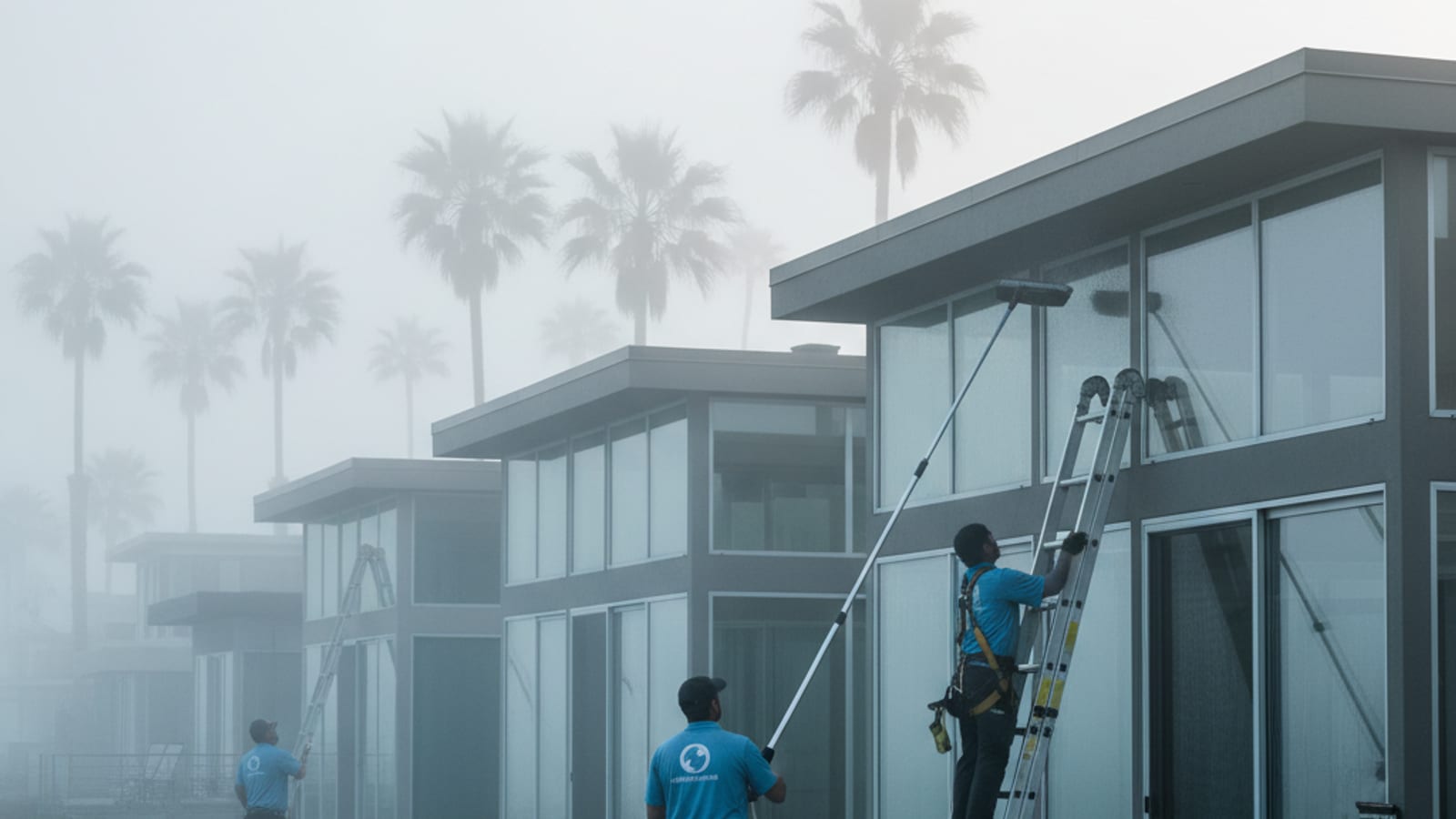
If you live within a mile of the ocean in San Diego, your exterior windows have a specific problem that inland homes never deal with: a fine mineral haze that forms on the glass from marine air, sits through every morning marine layer, and bonds increasingly strongly over time.
It isn’t dirt. Regular window cleaner won’t touch it. And if you ignore it for more than about 18 months, you move from “cleans off easily” to “needs restoration chemistry.” Here’s what’s happening and what actually fixes it.
What marine-air haze actually is
Coastal air carries microscopic droplets of sea water (the technical term is sea-salt aerosol) even when it’s not visibly foggy. Every marine-layer morning (which is most of them) those droplets deposit on every exterior surface within about a mile of the ocean. When they dry, they leave behind:
- Sodium chloride (salt). The dominant mineral.
- Magnesium chloride and calcium chloride. Smaller but present.
- Organic compounds. Trace amounts from sea-surface biology.
- Fine airborne dust. Not marine but blown onto the same sticky film.
Individually, none of these would be a problem. Together, on a glass surface, they form a progressively bonded film that behaves like hard-water deposits but is generated continuously rather than one spray at a time.
Why regular cleaning sometimes doesn’t work
The first few months of marine-air deposition come off easily with soap and water. At that stage the film is loose on the glass surface.
After about 3–6 months, the salt layer begins chemical bonding with the silicon dioxide of the glass. At this point regular cleaning removes the loose top layer but leaves a bonded sub-layer that looks like persistent haze.
After 12+ months, the bonding deepens. Aggressive cleaning with standard products can polish the glass back to apparent clarity but leave micro-etching that shows up on sunny afternoons.
After 2–3+ years, depending on how aggressive the local exposure is, the glass may have actual etching, permanent damage that only cerium oxide polishing can improve.
Who has this problem
- Homes in Oceanside, Carlsbad, Encinitas, Solana Beach, Del Mar, La Jolla, Pacific Beach, Mission Beach, Ocean Beach, Coronado, and Imperial Beach. Essentially any coastal community.
- Homes within roughly a mile of the water.
- Windows facing the water get it worst. Windows on the back side of the house get it significantly less.
- Homes on bluffs with full ocean exposure get it more intensely than homes inland of the first row.
How to tell if you have it
- Windows look foggy or hazy even after cleaning.
- Glass feels slightly rough when you run a finger across it.
- You can see a water-spot-like pattern concentrated on the lower half of exterior panes (this is where marine mist accumulates most heavily).
- The haze looks worse in direct afternoon sun than in diffuse morning light.
If you cleaned your windows six months ago and they already look cloudy, you probably have marine-air haze bonding.
What actually removes it
For light haze (3–6 months of accumulation)
- Standard professional window cleaning solution, but with a pre-wash step.
- Soak the glass with solution first, let dwell 3–5 minutes, agitate with a soft scrubber, then squeegee off.
- Rinse with clean water if possible to prevent redeposition as the cleaning solution evaporates.
For medium haze (6–18 months)
- Mild acidic hard-water removal product (CR-2 or similar).
- Apply with soft white pad, dwell 5–10 minutes.
- Scrub, rinse, squeegee.
- May need two passes on severely affected panes.
For heavy haze (18+ months)
- Full hard-water restoration treatment, often with cerium oxide polishing on stubborn spots.
- This is a separate service from regular cleaning, priced per affected pane.
- Budget $125–$250 per window depending on severity.
What doesn’t work
- Vinegar alone (not strong enough for bonded salt).
- Newspaper (an old home-remedy that works on light film but not on bonded deposits).
- Pressure washing (too aggressive, can damage seals and frames, and doesn’t actually remove bonded mineral).
- Soap and water (the problem in the first place, since regular cleaning leaves the bonded layer behind).
How to prevent new haze
You can’t stop the marine air, but you can manage how long deposits sit.
Schedule on a coastal cadence
Quarterly cleaning is the sweet spot for most coastal homes. At that interval, deposits never get past the “loose film” stage. Semi-annual is the minimum for homes within a mile of the water.
Bluff-top homes with full ocean exposure benefit from monthly touch-up cleaning on view-facing elevations. That sounds like a lot until you do the math: a small monthly touch-up at $75 versus a full restoration every 18 months at $600+ usually comes out cheaper and keeps the glass in better shape.
Hydrophobic sealant
After a clean restoration, a hydrophobic coating (similar to Rain-X but longer-lasting) slows the rate at which new deposits bond. Commercial products last 3–6 months; you can add this as an upgrade to a professional cleaning.
Sealant doesn’t stop deposition. It just makes deposits easier to remove on the next cleaning. The effect is small individually but compounds over time.
Rinse between cleanings
For coastal homes especially, a monthly plain-water rinse of exterior glass with a garden hose costs nothing and removes the loose film before it bonds. Five minutes per elevation, no soap, no cleaning, just plain water to keep the surface from accumulating.
Don’t let a sprinkler add to the problem
Marine-air deposition is hard enough. Don’t compound it by having a sprinkler spray the same glass. Adjust sprinkler heads away from all exterior-facing windows.
What we do on a coastal visit
- Full pre-wash and long-dwell cleaning on haze-prone elevations.
- Hard-water additive in the solution for homes past the 6-month threshold.
- Cerium oxide polishing on stubborn spots (added service, flat-rate per window).
- Optional hydrophobic sealant application.
- Track and sill service (salt collects there too, corrodes aluminum frames faster than most homeowners realize).
Coastal homes on our quarterly maintenance plan pay 25% below one-time pricing and never see bonded-stage haze. That’s the whole value proposition of a recurring route for coastal properties.
Call (858) 925-5546 and mention you’re within a mile of the water. We’ll quote the right cleaning for your specific elevation and tell you honestly whether you need restoration or just regular cleaning this visit.