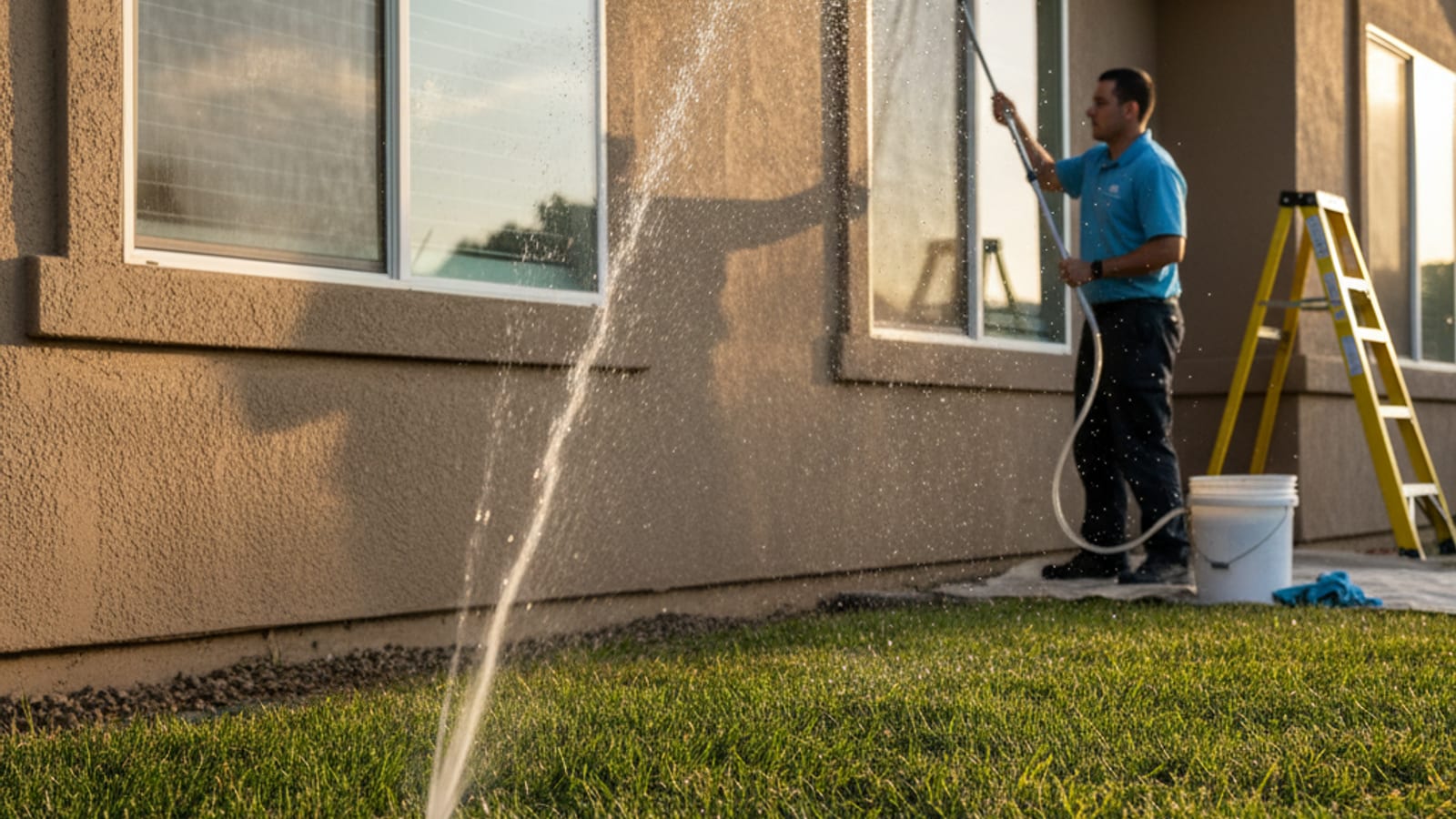
The hazy white rings, streaks, and cloud patterns that show up on exterior glass are almost always mineral deposits (calcium, magnesium, and sometimes silica or fluoride) left behind when hard water evaporates on the glass. They’re not dirt and they don’t come off with window cleaner. You can scrub all day and they’ll still be there.
Here’s what they are, what removes them, and (more importantly) how to keep them from coming back.
What causes hard water spots in San Diego
Three sources, in order of how often we see them:
1. Irrigation overspray. A sprinkler head aimed at or near a window. The water arcs, a portion hits the glass, the droplets evaporate in the sun, and the minerals stay. Within a year, you have a distinct spray pattern of spots, usually concentrated in the lower third of the window.
2. Pool splashback. Pool water contains calcium hardness (you add it deliberately to protect the plaster) plus dissolved salts if it’s a salt-chlorinated pool. Windows facing a pool collect a fine mist of pool water every time someone jumps in or the cleaner whips the surface.
3. Coastal marine air. Homes within a mile of the ocean get salt-laden air deposition constantly. Salt behaves similarly to hard-water minerals: it bonds to the glass, it accumulates, and eventually it etches.
Why you can’t just scrub them off
Hard water minerals chemically bond to the silicon dioxide surface of the glass. It’s not a physical layer of crud sitting on top; it’s a mineral-glass interaction at the molecular level. Scrubbing harder makes it worse. You can scratch the glass but you can’t dislodge bonded mineral.
What actually works is acid chemistry that dissolves the mineral bond, or mechanical polishing with cerium oxide that removes a microscopic surface layer of glass (taking the bonded mineral with it).
What removes them
For light deposits (less than a year old, still reflective):
- A commercial hard-water removal product (CR-2, Glas-Weld Hard Water Stain Remover, Bio-Clean, or similar). These are mildly acidic (citric, phosphoric, or oxalic acid) and dissolve the mineral without damaging the glass.
- Apply, let it dwell for 3–5 minutes, scrub gently with a soft white scrub pad, rinse thoroughly, squeegee off.
- Almost always fully effective on light deposits.
For medium deposits (1–3 years old, slight haze):
- Same chemistry but with more dwell time and possibly a second pass.
- Sometimes a mild cerium oxide polish as a finishing step to remove any lingering haze.
For heavy deposits (3+ years, clearly etched, feels textured to the touch):
- The mineral has etched into the glass surface. Chemical removal alone won’t restore clarity.
- Cerium oxide hand polishing is the only real option. Takes 15–30 minutes per window depending on severity.
- Sometimes improves but doesn’t fully erase. At that point you’re deciding between partial restoration and glass replacement.
What does NOT work (and can make it worse)
- Muriatic acid. Yes, it dissolves mineral. It also etches glass, damages metal frames and seals, and is dangerous to handle. Never use this.
- Razor blades. Not for mineral removal. A razor can slip off mineral and scratch the glass around it.
- Abrasive pads (green Scotch-Brite, steel wool). These scratch glass. Use only white scrub pads or soft-bristle brushes.
- Vinegar alone. Vinegar is mildly acidic and can help on very light deposits, but for anything more than a couple months old it just isn’t strong enough.
- Glass scratching products marketed as “heavy duty.” Most are abrasive pastes that grind the glass surface down. They work by removing material, not by dissolving mineral, so they create their own new surface damage.
How to stop new spots from forming
This is where most homeowners miss the point. You can restore the glass once and pay again in eight months if you don’t fix the source.
Fix the irrigation first
- Walk the yard during a watering cycle. Watch what hits your windows.
- Adjust sprinkler head angles so spray lands on the grass or beds, not on the house.
- For sprinkler heads near walls, consider replacing with drip irrigation. Drip water never becomes airborne.
- Check spray direction after every gardener visit, since they sometimes knock heads out of alignment.
- If the irrigation zone is inherited from a previous owner and can’t be adjusted well, reconfigure it. A half-day sprinkler adjustment by a landscaper is cheaper than annual hard-water restoration forever.
Address pool splashback
- If you swim regularly and pool-facing windows accumulate spots, consider a splash baffle or screen along the pool edge.
- Rinse pool-facing windows with plain water after heavy use. Getting the pool mist off before it evaporates prevents bonding.
- Cover the pool when not in use (this also helps with evaporation and chemical load).
For coastal homes
- You can’t fix the ocean. Marine-air deposition is part of living there.
- What you can do: schedule cleaning on a quarterly cadence so deposits never sit long enough to bond deeply.
- Ask for a hydrophobic sealant on your view-facing glass after a cleaning. It slows redeposition by 30–50% and buys you more time between cleanings.
- Rinse coastal glass with plain water once a month between professional cleanings. A garden hose and five minutes per elevation cuts annual restoration costs significantly.
When to call in professional restoration
Call a pro when:
- You’ve tried standard window cleaner and the spots remain.
- You can feel the spots by running a finger over the glass.
- The spots are distributed in a spray pattern (sprinkler) rather than random (dirt).
- The glass has gone cloudy across a whole section rather than spotted.
- You’re about to sell the home and appraisal photos are in the calendar.
DIY chemical removal can work on light deposits if you’re comfortable with the chemistry and willing to do a test patch first. For anything heavier, the labor-to-material math strongly favors hiring it out. Pros have better chemistry, proper equipment, and they own the outcome.
What we actually do
Our hard-water restoration process:
- Assay. We test the mineral on a small patch to identify the deposit and match the right chemistry.
- Protect. Drop cloths below, landscape shields where the water will run off.
- Apply. Professional-grade hard-water removal compound, dwell time based on severity.
- Agitate. Soft white pad, not abrasive, never razors.
- Polish (if needed). Cerium oxide hand polish on stubborn deeply-bonded spots.
- Rinse and squeegee. Back to clear.
- Seal (optional). Hydrophobic coating to slow redeposition.
- Recommend. If the source is a sprinkler we can see, we tell you which head. If it’s pool splash, we tell you where to baffle. No extra charge for the advice.
Typical restoration runs $95–$250 per affected window depending on severity. A whole-house restoration with 10–15 affected windows runs $800–$2,400. We quote flat-rate after seeing the glass.
If you’re looking at hard-water spots right now and wondering if they can come off, in most cases, yes. Call (858) 925-5546 and we’ll take a look.