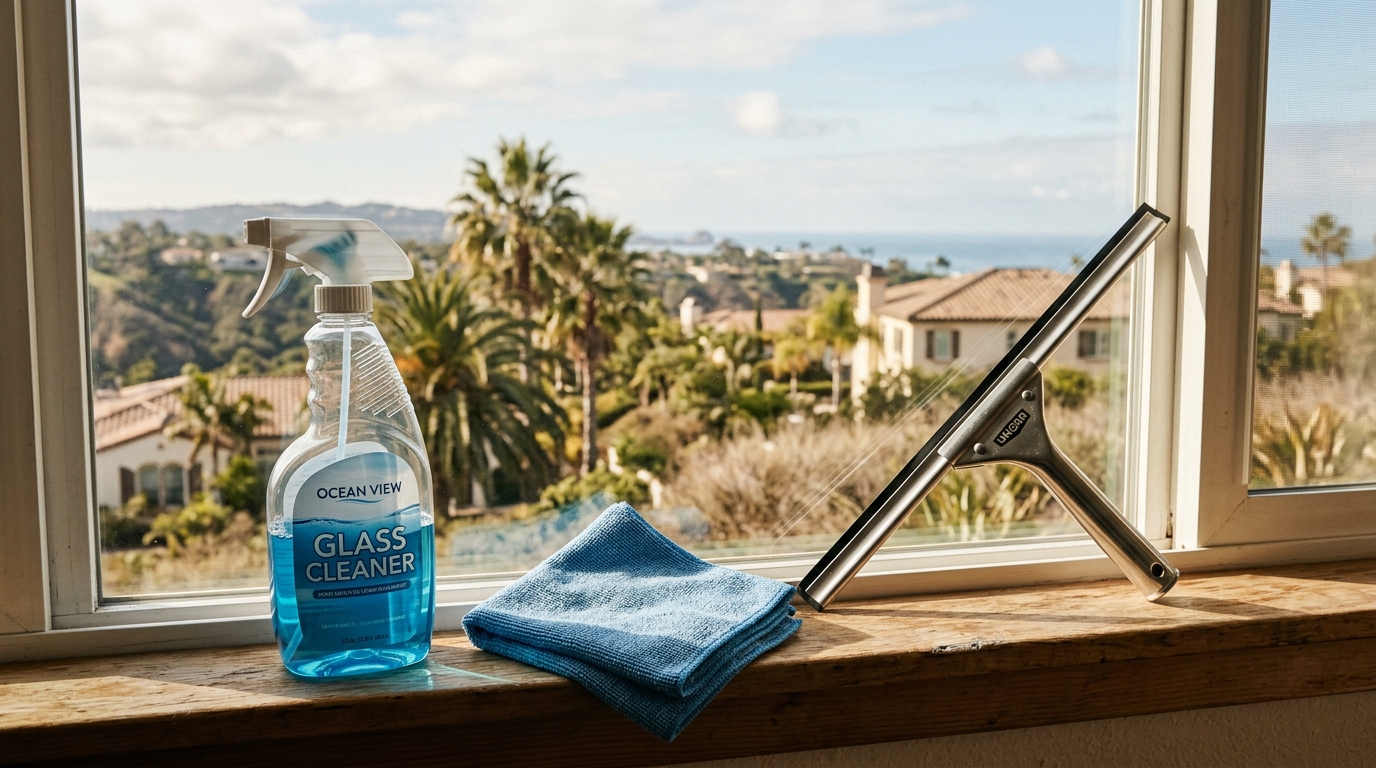
The best glass cleaner for most home windows is a few drops of plain dish soap in purified water. That’s what professional window cleaners actually use. Retail sprays like Windex work fine on small panes, but they leave residue that streaks faster outdoors, and they do nothing for the mineral spotting that San Diego hard water and coastal salt leave behind. Here’s an honest breakdown of every common option, what each one is actually good for, and where each one falls short.
The main options and what they’re actually for
There’s no single best cleaner for every situation. The right choice depends on whether you’re doing inside or outside glass, how dirty the window is, whether you have tinted glass, and whether you’re dealing with hard-water mineral spots. Here’s how the common options stack up.
Ammonia-based cleaners (Windex and similar)
Windex and other ammonia-based sprays cut grease fast. That makes them excellent on interior glass that’s picked up fingerprints, cooking spray, or indoor grime. They evaporate quickly and leave little residue on a clean interior pane.
The problem is outdoors. On exterior glass, the ammonia can react with dried salt film and accelerate residue buildup. On tinted windows, ammonia degrades the tint film over time. Most auto glass manufacturers specifically warn against it for this reason, and the same applies to window film installed inside your home for privacy or UV protection. If your windows have any kind of film or tint, skip ammonia entirely.
Vinegar and water
A 50/50 mix of white vinegar and water is the most common DIY alternative, and it earns its reputation on interior glass that’s mostly just dusty or lightly grimy. Vinegar is acidic, which helps dissolve light mineral deposits better than plain water. Our post on cleaning windows with vinegar covers technique, but the short version is: it works on light buildup if you wipe before it dries.
The limitation is that vinegar isn’t strong enough for genuine hard-water mineral spotting. San Diego’s water is moderately hard, and homes that get sprinkler overspray on their glass or live within salt range of the coast accumulate calcium and magnesium carbonate that vinegar alone won’t fully lift. Vinegar is also slow on heavy exterior grime, and the smell lingers if you’re cleaning inside.
Dish soap and water
This is what most professional window cleaners use. A few drops of unscented, low-suds dish soap (Dawn original is common) in a bucket of water makes a solution that lubricates the squeegee, breaks down surface grime, and rinses clean without leaving a film. The key word is “few”: too much soap means suds that leave their own residue.
Dish soap is gentle on every glass type, including tinted and filmed surfaces. It works well on both interior and exterior glass. And it’s cheap enough to mix fresh every time, which matters because re-used dirty solution is one of the most common causes of streaking. The dish-soap-and-water method works best with a proper squeegee and technique, not a paper towel or microfiber alone.
Purified or deionized water
This is the other thing professionals use, and it’s the bigger differentiator. Purified water means water with the minerals filtered out, typically through a multi-stage filtration and deionization system that window cleaning companies run in a trailer or van tank. The water’s mineral content reads near zero on a TDS meter.
Why does this matter? Because streaks and spots on windows after cleaning are almost never from the soap. They’re from the minerals in the rinse water drying on the glass. Regular tap water in San Diego carries around 300 to 600 parts per million of dissolved solids depending on whether you’re in a coastal district served by desalinated water or an inland area drawing from Colorado River supply. When that water dries on glass, it leaves a visible haze. Purified water dries without leaving anything behind. That’s why a professional crew can rinse and let glass air-dry and still get streak-free results.
What San Diego’s water actually does to windows
San Diego’s water supply is harder than most of the West Coast. Homes that get sprinkler overspray on glass, which is most mid-county neighborhoods in areas like Santee, El Cajon, Poway, and Spring Valley, develop a calcium carbonate buildup over months and years that standard cleaners can’t remove. Scrubbing it harder doesn’t work. You need an acid-based treatment to dissolve the bond, followed by a neutral rinse.
Coastal homes have a related but different problem. Marine air deposits sodium chloride and other sea salts on glass surfaces constantly. Salt film isn’t a mineral spot in the same sense, but it hazes glass and, when combined with hard water from sprinklers or rain, creates a layered buildup that resists standard soap-and-water cleaning. Our post on hard water spots: how to remove and prevent them covers treatment in more detail.
If you’re dealing with either of these and you’re trying retail glass cleaner on them, you’re not going to see results. Those products are made for everyday grime, not bonded mineral deposits.
Tinted windows and window film
If your windows have any kind of tint or film, ammonia is off the table. That includes factory tint on newer homes, aftermarket privacy film, UV-blocking residential film, and most decorative films. Ammonia breaks down the adhesive and discolors the film over time.
For tinted glass, use dish soap and water or a mild non-ammonia spray. Microfiber cloths are safer than squeegees on film because there’s no metal edge risk. Avoid anything labeled “heavy duty” or “degreaser” unless the product specifically says it’s safe for window film.
Interior versus exterior glass
The cleaning method can differ between the two, and that’s worth knowing before you buy anything.
Interior glass is usually dealing with dust, fingerprints, pet nose prints, and the occasional cooking splatter. It’s dry, and it hasn’t been rained on. A spray bottle with diluted dish soap or a non-ammonia glass cleaner and a good microfiber cloth handles it. Ammonia-based sprays like Windex work fine here if you don’t have tinted glass.
Exterior glass is dealing with pollen, bird droppings, sprinkler water, rain runoff, and in San Diego, salt film. It needs a full wash, not just a spray-and-wipe. The professional approach is a soapy scrub with a window cleaning applicator or soft-bristle brush, followed by a squeegee pull, then a purified-water rinse. Trying to do exterior glass with a spray bottle and paper towels is where most DIY window cleaning goes wrong.
When to call a professional instead
DIY cleaning with dish soap and water will keep interior glass clean and remove light exterior grime. It won’t fix hard-water mineral etching, heavy exterior buildup, or second-story glass where safe access is the real problem.
Hard-water spotting that’s been on glass for more than a year often requires professional-grade acid treatment to dissolve the mineral bond before cleaning can begin. Doing that wrong can scratch glass permanently. Our hard-water removal service is designed specifically for this.
For regular exterior maintenance on a San Diego home, the difference between DIY and professional is mostly time and equipment. A professional crew has purified water, proper squeegees, and knows how to handle San Diego’s specific glass conditions. Our residential window cleaning service covers interior and exterior glass, screens, and tracks, with upfront pricing before we start. If you’re near the coast or dealing with mineral spots, it’s worth calling us at (858) 925-5546 to find out what you’re actually dealing with.
You can also compare the DIY versus professional tradeoffs in full at our post on DIY vs. professional window cleaning.
The short comparison
| Cleaner | Best for | Avoid when |
|---|---|---|
| Ammonia-based (Windex) | Interior glass, no tint | Tinted or filmed windows, exterior |
| Vinegar and water | Light interior grime, DIY | Heavy mineral spots, exterior buildup |
| Dish soap and water | All glass types, exterior | You use too much soap |
| Purified/deionized water | Streak-free rinse on any glass | You only have tap water available |
| Retail spray (non-ammonia) | Touch-ups, small interior panes | Serious buildup, hard-water spots |
FAQ
What do professional window cleaners actually use?
Most professional window cleaners use a small amount of dish soap mixed into a bucket of water for washing, then rinse with purified or deionized water. The purified water is what makes the difference: it dries without leaving mineral residue, so glass air-dries streak-free without a second pass. Retail spray cleaners like Windex are rarely part of the professional setup.
Is Windex good for windows?
Windex works well on interior glass that isn’t tinted. It cuts grease fast and evaporates quickly. The problems are with exterior glass, where it builds residue faster outdoors, and with any tinted or filmed window, where ammonia degrades the tint over time. For those situations, use dish soap and water or a non-ammonia alternative instead.
Can I use vinegar to clean windows?
Yes, for light interior grime and lightly dusty glass. A 50/50 dilution of white vinegar and water dissolves light mineral deposits and evaporates without leaving much residue. It’s not strong enough for hard-water mineral spotting that’s bonded to the glass, and it’s slow on heavy exterior buildup. For those situations, you need either an acid-based mineral treatment or professional service.
What causes streaks after cleaning windows?
Streaks almost always come from minerals in the rinse water, not the soap. When tap water dries on glass, dissolved calcium, magnesium, and other minerals stay on the surface as a haze. San Diego tap water is moderately hard, which makes this a real problem here. The fix is rinsing with purified water or wiping dry before the water can dry on its own.
What glass cleaner is safe for tinted windows?
Non-ammonia options only. Dish soap and water is the safest and most effective choice for tinted glass and windows with installed film. Mild spray cleaners labeled “film-safe” or “tint-safe” are also fine. Ammonia-based cleaners like Windex break down the adhesive and discolor tint over time, so they should never be used on any filmed or tinted surface.
Why do my windows get spotted again so quickly after cleaning?
In San Diego, the most common causes are sprinkler overspray depositing hard water on the glass and coastal salt film settling from marine air. Standard glass cleaners remove surface grime but don’t treat the underlying mineral buildup that’s bonded to the glass. Once the bond is established, each new water deposit sticks to the existing layer and the spotting comes back faster each cycle. Professional hard-water removal dissolves the bond and resets the glass. Preventing it afterward means keeping sprinkler heads aimed away from windows and cleaning more frequently if you’re near the coast. Our window cleaning service for San Diego County can help you figure out the right schedule for your home’s location and conditions.