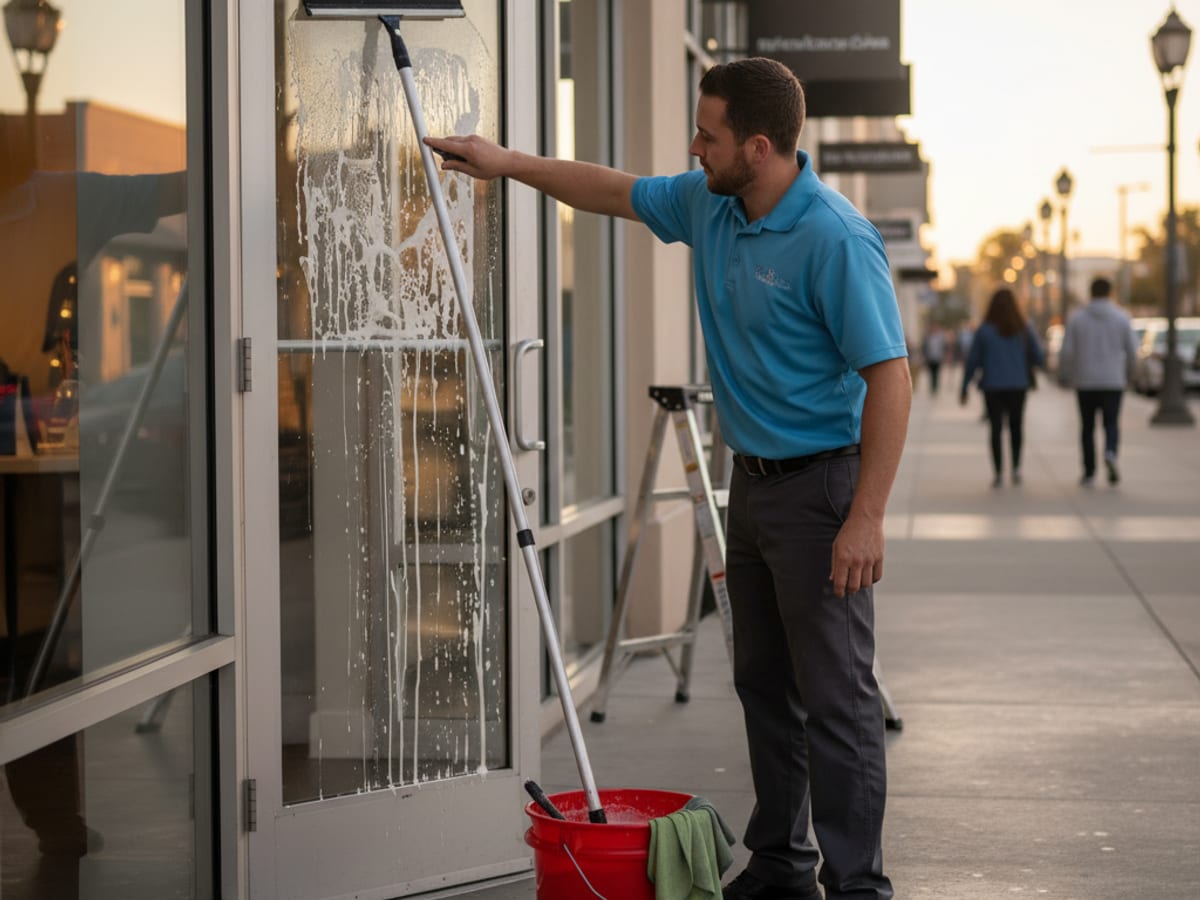
Commercial window cleaning in San Diego means cleaning the glass on a business: storefronts, office suites, restaurants, medical buildings, and mid-rise towers. Most local buildings need exterior service monthly or quarterly, with interiors on a slower cadence. What changes the schedule here is the coast. Salt air and hard water deposit mineral film that bonds to glass faster than it does inland, so a downtown or beach-adjacent building dirties differently than one in El Cajon.
Here’s how to think about it for an actual San Diego property, not a generic template.
Why San Diego commercial glass is different
National window-cleaning brands run the same page in every city. Same “free estimate” button, same “weekly, monthly, or quarterly,” nothing about where you actually are. That’s fine until you own a building near the water and your glass keeps hazing over three weeks after a cleaning.
Two local forces drive that. First, marine salt air. Buildings within a mile or two of the coast, think downtown, Coronado, Pacific Beach, La Jolla, get a fine salt film on exterior panes year-round. Second, hard water. San Diego’s tap water is mineral-heavy, so sprinkler overspray, irrigation, and cooling-tower drift leave spots that etch into glass over time. We cover both in depth in our guides on coastal salt haze on windows and removing and preventing hard-water spots.
The marine layer makes it worse. Morning fog wets the glass, afternoon sun bakes it, and that wet-dry cycle speeds mineral bonding. A storefront on Garnet Avenue and an office in Rancho Bernardo are not on the same schedule, and any quote that treats them the same is guessing.
How often commercial buildings actually need it
Frequency is about appearance standards, location, and what hits the glass. Here’s what we see across San Diego County.
| Building type | Typical exterior cadence | Interior cadence |
|---|---|---|
| Coastal storefront or restaurant | Monthly to bi-weekly | Monthly |
| Downtown / UTC office | Monthly to quarterly | Quarterly |
| Inland office or retail | Quarterly | Twice a year |
| Medical / dental | Monthly | Monthly |
| Mid-rise (4+ stories) | Quarterly | Twice a year |
| Industrial / Sorrento Valley flex | Quarterly to twice a year | Annually |
A few patterns hold across all of them. Customer-facing glass at eye level needs more frequent service than upper floors. Coastal buildings run roughly one tier more often than inland equals. And restaurants with patio misting or street-level dust almost always need monthly, sometimes more.
If your glass looks hazy within three weeks of a cleaning and you’re near the water, that’s not a cleaning-quality problem. That’s the cadence being wrong for the location.
What commercial service includes
Commercial work is broader than wiping panes. A real scope covers:
- Exterior and interior glass on every accessible elevation
- Frames and sills wiped down, not just the glass
- Window tracks cleared of grit and debris, which matters more on coastal buildings where salt and sand collect
- Entry doors and glass partitions, the highest-touch surfaces in any business
- Screens rinsed and reset where present
- Skylights and atrium glass on a slower, scheduled cadence
For storefronts and ground-floor suites, most of the value is in the entry glass and street-facing windows. For office towers, it’s about a consistent whole-building appearance from the parking structure to the top floor. Buildings above three or four stories move into high-rise window cleaning, which uses different access methods and scheduling.
San Diego commercial districts and what they deal with
Different parts of the county throw different problems at your glass.
Downtown and the Gaslamp. Street-level dust, exhaust film, and foot-traffic smudging on entry glass. High visibility, so appearance standards are strict. Salt air reaches the waterfront blocks. Most downtown ground-floor businesses do well on monthly exterior service.
UTC and La Jolla. A mix of corporate offices and upscale retail near the coast. Salt film plus high appearance expectations. Quarterly works for upper office floors, monthly for retail and lobby glass.
Sorrento Valley and Mira Mesa. Office parks and flex/industrial space. Less foot traffic, more dust and irrigation overspray from landscaped lots. Quarterly is usually right, with attention to hard-water spotting on ground-floor glass near sprinklers.
Coastal corridors (PB, Mission Beach, Coronado, Encinitas, Oceanside). The hardest assignment in the county. Salt is relentless and the marine layer accelerates bonding. Restaurants and shops here often need bi-weekly or monthly to stay sharp.
Inland (Escondido, San Marcos, El Cajon, Chula Vista). Lower salt exposure, more seasonal dust and pollen. Quarterly exterior service handles most inland commercial buildings well.
What it costs in San Diego
Commercial window cleaning is priced per building, not per pane, because access, height, glass count, and frequency all move the number. Most national sites publish nothing at all. Here’s an honest range for typical San Diego commercial work.
| Building | Rough one-time range | Notes |
|---|---|---|
| Small storefront (1 unit) | $75 to $200 | Entry glass plus street-facing windows |
| Strip-mall suite | $150 to $400 | Per tenant, interior and exterior |
| Single-story office | $250 to $600 | Depends on glass count and screens |
| Restaurant with patio glass | $200 to $500 | Frequent service usually needed |
| Two-to-three-story office | $400 to $1,200 | Access method affects price |
| Mid-rise (4+ stories) | Custom quote | Height and access drive cost |
A few things move the price up: hard-water restoration on neglected glass, post-construction cleanup, hard-to-reach elevations, and tight scheduling windows. Things that move it down: a recurring contract, ground-floor access, and glass that’s been maintained rather than restored.
Recurring service almost always beats one-time pricing for a business. Frequency keeps the glass from crossing the line where a routine clean becomes a restoration job, and a regular schedule means a predictable monthly cost instead of surprise invoices. The same logic that applies to homes applies harder to businesses, which we break down in maintenance plans versus one-time cleaning.
We give upfront quotes. You’ll know the number before any work starts, not after.
When hard water turns into a real problem
This is the trap for commercial buildings near sprinklers or the coast. Mineral spots that get ignored don’t stay spots. They etch. Etched glass is a four-figure restoration per elevation, sometimes a glass-replacement conversation, and no amount of regular cleaning reverses it once it’s set.
The warning sign is spots that reappear within days of a cleaning, or a cloudy haze that doesn’t wipe away. If that’s happening, the fix order is: correct the source (sprinkler aim, irrigation overspray), restore the affected glass once, then return to a normal cadence that keeps it clear. Commercial buildings with landscaped lots are the most common victims because nobody notices the sprinkler hitting the lobby glass every morning.
Choosing a commercial window cleaner in San Diego
A short checklist before you sign anything:
- Do they ask about your location and what hits your glass? A coastal building and an inland one shouldn’t get the same plan.
- Do they quote upfront? You should know the price before work starts.
- Do they handle hard water and salt film, or just routine cleaning? Coastal buildings need both.
- Can they match your schedule? Restaurants and retail often need off-hours service so glass isn’t being cleaned during business hours.
- Do they cover the full county? A real San Diego operator serves downtown, the coast, and inland, not one zip code.
That’s the difference between a national template and someone who actually knows San Diego glass.
FAQ
How much does commercial window cleaning cost in San Diego?
It depends on building size, height, glass count, and frequency. A small storefront often runs $75 to $200, a single-story office $250 to $600, and mid-rise buildings get a custom quote. We give the number upfront before any work starts.
How often should a San Diego business clean its windows?
Coastal storefronts and restaurants usually need monthly or bi-weekly exterior service. Inland offices and retail do well quarterly. Customer-facing entry glass always needs more attention than upper floors. Medical and dental buildings typically run monthly.
Why does my commercial glass haze over so quickly near the coast?
Salt air deposits a mineral film on exterior glass, and the marine layer’s wet-dry cycle speeds bonding. Buildings within a mile or two of the water see haze within a few weeks. That’s a cadence problem, not a cleaning-quality one. More on it in our coastal salt haze guide.
Can you clean windows after business hours?
Yes. Many restaurants, retail stores, and offices schedule service before opening or after closing so the work doesn’t interrupt customers or staff.
Do you handle high-rise and mid-rise buildings?
Buildings above three or four stories use different access methods and scheduling. See our high-rise window cleaning service for how that works.
What if my building has hard-water spots that won’t come off?
Those are mineral deposits that have started bonding to the glass. They need a restoration treatment, not a routine clean, and the source (usually sprinkler overspray) has to be corrected first. Left alone, they etch the glass permanently.
Get a quote on your building
Tell us where your building is and what’s on the glass, and we’ll give you an honest cadence and an upfront price. We cover all of San Diego County, from coastal storefronts to inland office parks, and we know the difference between salt film, hard water, and everyday grime.
Call us at (858) 925-5546 for a quote on your commercial property. You’ll get the right schedule for your building and location, not a one-size-fits-all package.