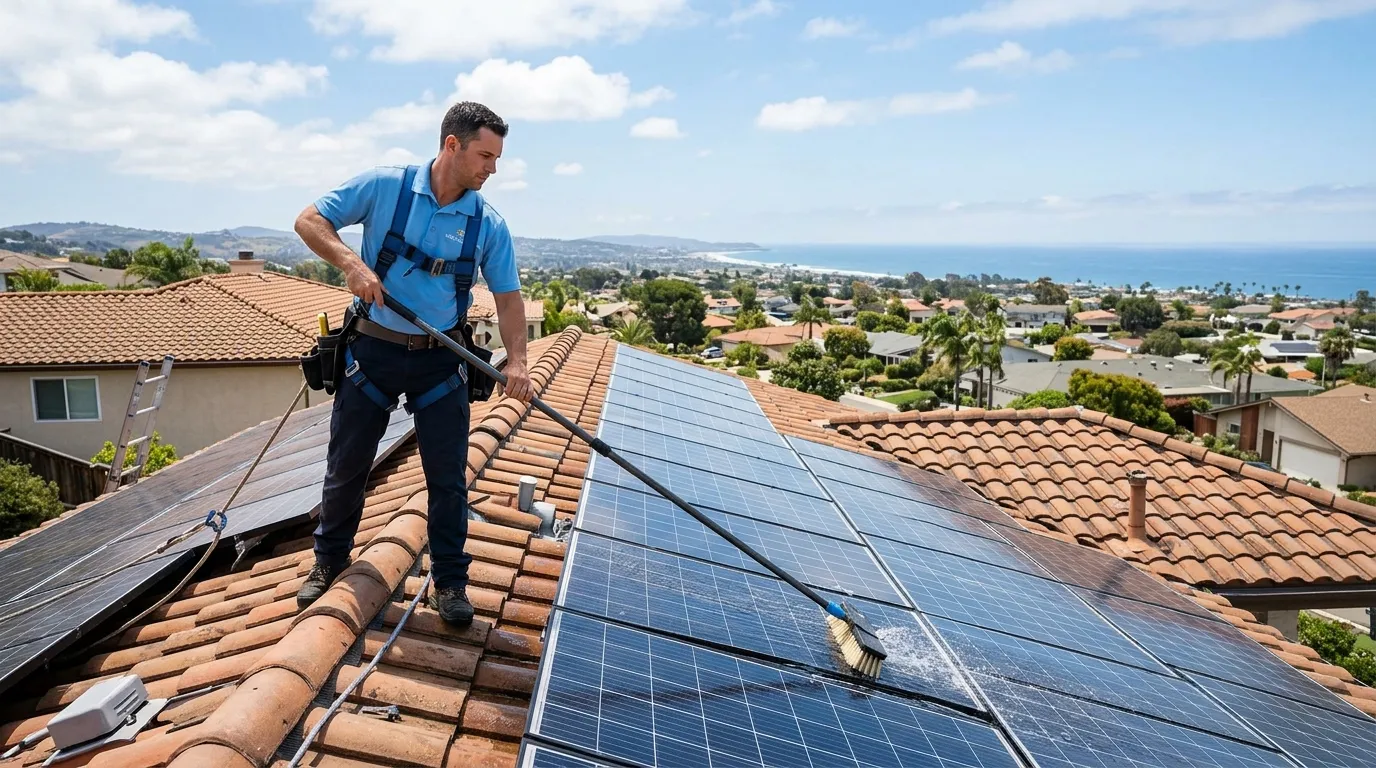
Solar panel cleaning in San Diego runs $8 to $15 per panel, with most residential jobs landing between $150 and $400 depending on panel count, roof height, and access difficulty. Ground-mounted arrays are usually at the lower end. Two-story rooftop installs with steep pitches sit at the higher end. Flat-rate minimums typically start around $150 regardless of panel count, so smaller arrays on accessible roofs won’t get cheaper than that floor.
Here’s how the number gets built, what San Diego conditions add to it, and where bundling with window cleaning makes economic sense.
What solar panel cleaning costs in San Diego (2026)
The per-panel rate is the clearest way to estimate a job, with roof access and panel count as the main variables.
| Scope | Typical San Diego range |
|---|---|
| Per panel, single-story roof | $8 to $12 |
| Per panel, two-story roof | $10 to $15 |
| Ground-mounted array | $6 to $10 per panel |
| Flat-rate minimum (any job) | $150 |
| Typical 20-panel home, single-story | $160 to $240 |
| Typical 20-panel home, two-story | $200 to $300 |
| Larger 30-panel array, two-story | $300 to $450 |
| Bundled with window cleaning | 10 to 20 percent less |
Panel count varies widely. A modest grid-tied system in San Diego runs 12 to 16 panels. A full home-plus-EV setup often runs 28 to 40. Count yours before calling, and expect that number to be the first question any company asks.
What drives the price up or down
A few variables move a solar cleaning quote more than people expect.
Roof height and pitch. Single-story access is fast. A two-story home with a steep pitch takes longer because the crew either uses a longer water-fed pole, rigging, or works more carefully on the roof surface. That time shows up in the per-panel rate. Low-slope single-story roofs are where the best per-panel prices happen.
Ground-mount vs. roof-mount. Ground-mounted arrays are the cleanest job in solar cleaning. The crew walks up, cleans the panels at chest height, and moves on. No roof access, no ladder setup. That saves time and reduces cost per panel compared to rooftop work.
Panel condition and soiling type. Routine dust is fast. Bird droppings, wildfire ash, and hardened coastal salt are slower. A panel with heavy point-source contamination, like a bird dropping baked on in summer heat, takes direct hands-on cleaning, not just a rinse. Some companies add a soiling surcharge for panels that haven’t been cleaned in two or more years.
System size and layout. Panels stacked in a clean grid clean faster than panels split across multiple roof planes, multiple pitch angles, or with obstructions like skylights and vents between them. Fragmented layouts mean more crew movement and repositioning.
Frequency. One-time cleanings carry the full visit cost. On a recurring maintenance plan, the per-visit rate drops because scheduling is predictable and the setup overhead is spread across multiple jobs. Most San Diego homeowners with solar do best on an annual or twice-yearly cadence. We compare the economics in maintenance plan vs. one-time cleaning.
Why San Diego panels need cleaning more than most markets
San Diego’s dry season runs roughly May through November, sometimes longer. That’s six-plus months where coastal salt, airborne dust, pollen, and bird droppings accumulate on panels with no rain to rinse them. Rain in December and January helps, but a light rain on a dusty panel can deposit more residue than it removes if it doesn’t come down hard enough to actually flush the surface.
Three San Diego-specific factors push panels toward dirty faster.
Coastal salt. Within two miles of the ocean, marine air deposits a fine mineral film that hazes glass surfaces, solar panels included. It’s the same haze that hits windows in La Jolla, Pacific Beach, Coronado, Encinitas, and Carlsbad. Salt also acts as a binding agent, making dust stick faster and harder to rinse without proper technique.
East County and inland corridor dust. Homes in El Cajon, Santee, Ramona, Spring Valley, and Alpine face dry hillside dust year-round. The dry offshore winds (Santa Ana conditions) accelerate deposition and push fine particles into the panel surface texture.
Bird activity. San Diego’s year-round warm weather keeps birds active on rooftops every month. Gull populations near the coast and pigeons near urban corridors leave concentrated droppings. A single bird dropping on one cell can cause that cell to run hotter than its neighbors, which over time affects output and can stress the panel material. This is one reason bird droppings specifically get attention during a proper cleaning, not just a rinse pass.
If you want the full picture of what builds up on San Diego panels and why it matters for production, we covered it in solar panel cleaning in San Diego: does it actually matter.
Why the cleaning method matters for your warranty
Most panel manufacturer warranties require cleaning with deionized water and soft brushes, and prohibit high-pressure water, abrasive pads, detergents, and cold water on hot glass. These aren’t minor details. Cleaning your panels with a pressure washer or harsh chemical can void the output warranty.
A professional solar panel cleaning uses DI water, which leaves no mineral spots when it dries, soft solar-specific brush heads that won’t scratch the anti-reflective coating, and low-pressure delivery. We reach most residential rooftop arrays from the ground using water-fed carbon-fiber poles, which keeps crew off the panels entirely.
DIY cleaning is possible on single-story accessible arrays with the right equipment, a portable DI cartridge and a soft solar brush on a pole, and the approach matters. If you’re on a two-story roof in August to clean panels at noon with a garden hose, the risk of thermal shock, warranty damage, and a fall make a $200 professional cleaning the obvious call. For ground-mounted arrays, DIY is more practical, but the DI water piece still matters. Tap water leaves calcium spots that reduce light transmission.
Bundling solar cleaning with window cleaning
The most cost-effective time to clean solar panels is when a window cleaning crew is already on site. Same truck, same setup, same visit. Most companies, including us, offer a discount when the jobs run together, typically 10 to 20 percent off the solar cleaning portion.
For a typical San Diego home with 20 panels and 18 to 24 windows, a bundled visit runs roughly $350 to $550 total depending on stories and panel access, compared to $250 to $400 for windows alone plus $150 to $300 for a standalone solar job. The math on bundling is usually $50 to $100 saved per visit.
The scheduling also works well together. Both jobs benefit from an annual or twice-yearly cadence in San Diego. Spring cleaning catches the end of pollen season and primes both windows and panels for summer. A fall visit undoes six months of dry-season accumulation before the rainy season starts. We cover the full window cleaning pricing side in window cleaning cost in San Diego, and you can see both services on our residential window cleaning and solar panel cleaning pages.
For a quote on your home anywhere in San Diego County, call us at (858) 925-5546 or start from the San Diego window and solar cleaning hub.
FAQ
How much does solar panel cleaning cost in San Diego?
Most residential jobs run $150 to $400, or about $8 to $15 per panel. Single-story rooftops and ground-mounted arrays are at the lower end. Two-story installs with steep pitches or fragmented roof layouts sit higher. A flat-rate minimum around $150 applies regardless of panel count, so small arrays won’t come in cheaper than that.
How often should I clean solar panels in San Diego?
Once a year works for most homes. Twice a year is better if you’re within two miles of the coast, under a tree canopy, near agricultural land, or see consistent bird activity on your roof. San Diego’s long dry season means six-plus months of dust, salt, and droppings accumulate with no rain to clear them.
Does bundling solar and window cleaning save money?
Yes. Booking both on the same visit typically saves 10 to 20 percent off the solar cleaning portion, since the crew and truck setup costs are shared. For a home with both needs, bundling is almost always the better deal.
Can I clean solar panels myself?
On a single-story roof with a ground-accessible array, yes, if you use deionized water and a soft solar brush on a pole. Skip the pressure washer, the abrasives, and any detergent. On a two-story or steep-pitch roof, the access risk and potential warranty implications make a professional service the better call.
What method do professionals use so it doesn’t void my warranty?
Deionized water delivered at low pressure through a soft-bristle solar brush. DI water rinses spot-free without leaving mineral residue. Soft bristles won’t scratch the panel’s anti-reflective glass coating. Most panel warranties require this method and specifically prohibit high-pressure water, abrasive tools, and chemical cleaners.
Is solar panel cleaning worth it in San Diego?
Generally yes, especially for panels more than a year old that haven’t been cleaned. San Diego’s dry season means meaningful buildup over the summer and fall. Regular cleaning keeps panels producing at their rated output and protects the panel surfaces and warranty. The cost of one annual cleaning is usually well below the production value lost to a full season of soiling.