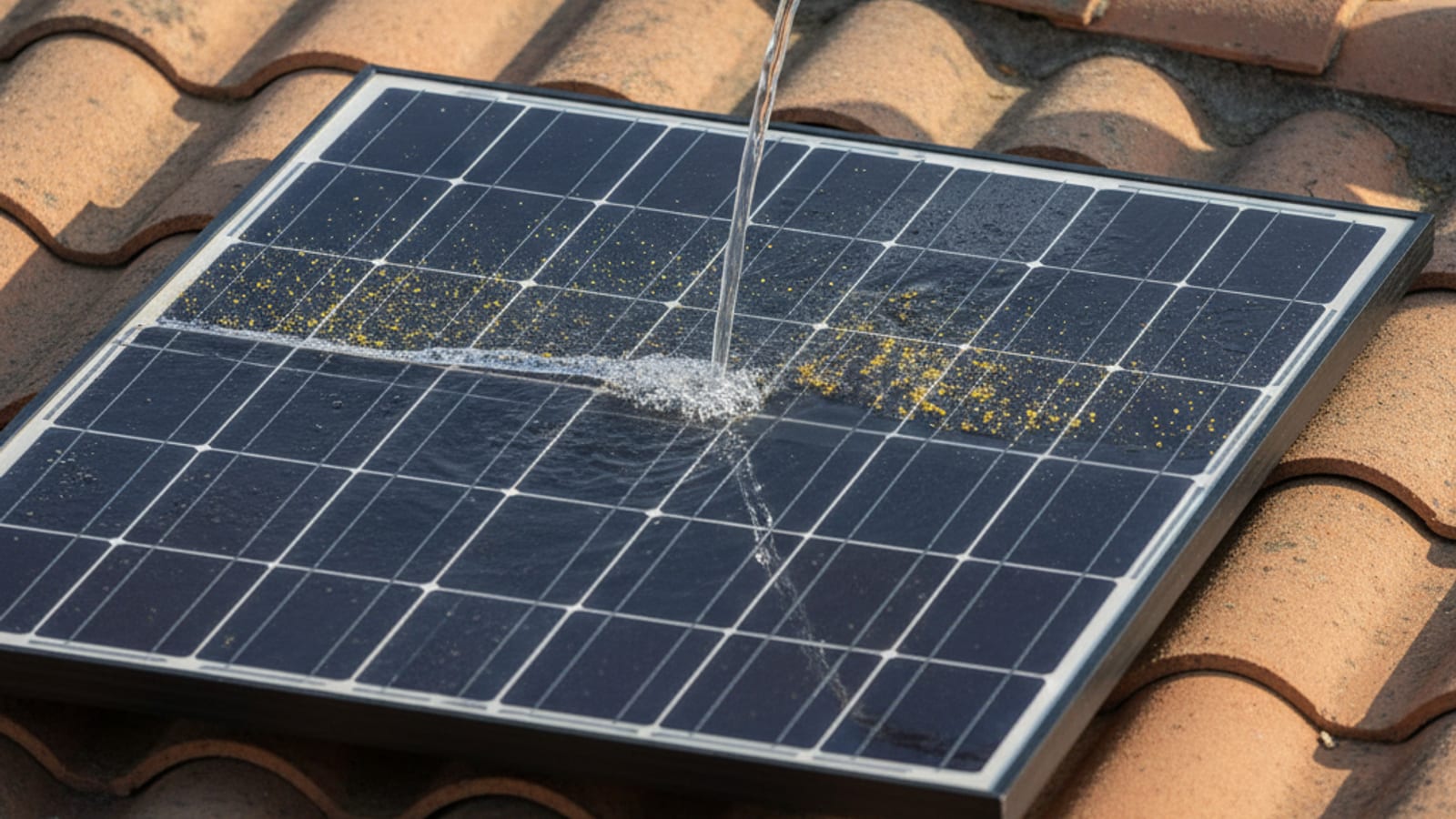
Short answer: yes, and more than most homeowners think.
The National Renewable Energy Laboratory (NREL) and multiple independent studies have measured solar-panel soiling loss in the 10–25% range depending on tilt, location, and the local dust environment. San Diego is middle-of-the-pack on dust and high on pollen, which means annual soiling loss here typically lands around 15–20% on a panel that hasn’t been cleaned in 12 months.
At current San Diego Gas & Electric tiered pricing (even after net-metering), a typical 6 kW residential array produces roughly 9,000–11,000 kWh annually. A 15–20% soiling loss equals 1,400–2,200 kWh of production you paid for and didn’t get. Translate that to dollars under NEM 3.0 export credits: $180–$430 per year.
An annual professional cleaning costs $180–$280. The math works.
What actually dirties the panels
- Airborne dust. Constant background deposition from dry hills, roads, construction.
- Pollen. Heavy in spring (March–May) and particularly rough on panels with flat or shallow tilts that don’t let pollen slide off.
- Bird droppings. Concentrated point-source soiling. Bird mess on a single cell can cause that cell to run hot (a “hot spot”) and eventually damage the panel.
- Wildfire ash. Event-driven but significant. Ash contains alkaline minerals that bond to glass more aggressively than dust.
- Salt (coastal). Marine-air salt deposits a haze similar to hard-water mineral deposits. Accelerates the rate at which dust bonds.
- Agricultural drift. Near avocado groves, orange groves, or commercial agriculture, panels get sprayed with fertilizer and soil particles carried on the wind.
Rain helps but doesn’t solve the problem. Rainwater with dissolved minerals can actually deposit more soiling when it dries than it removed. A light rain on a dusty panel forms mud-like deposits. A heavy rain in the right conditions does rinse panels mostly clean, but San Diego doesn’t get heavy rain consistently enough to rely on it.
Why cleaning them wrong voids your warranty
Most residential panel warranties explicitly require clean panels for the output warranty to apply, and almost all of them prohibit:
- High-pressure water. Exceeds the panel’s front-sheet pressure rating, can damage seals.
- Abrasive brushes or pads. Scratches the tempered glass anti-reflective coating.
- Detergents or cleaners. Residue interferes with light transmission and can damage anti-reflective coatings.
- Cold water on hot panels. Thermal shock can crack the glass.
- Walking on panels. Creates microcracks that degrade cells over time.
What the manufacturers actually allow is:
- Deionized (DI) water or soft water with neutral pH.
- Soft-bristle solar-specific brushes.
- Low-pressure delivery.
- Cleaning in cool conditions (early morning, evening) to avoid thermal shock.
That specification lines up exactly with professional solar-panel cleaning. The mismatch is what most homeowners try to do (a garden hose, regular tap water, a sponge on a pole, and noon cleaning in summer), which voids the warranty and can damage the panels.
Can I clean them myself?
On single-story homes with accessible arrays on a walkable roof pitch, yes, if you have DI water (you can buy a portable DI cartridge that attaches to a hose) and a proper soft solar brush, and you stay off the panels themselves.
On two-story or steeper homes, no. Roof falls are the leading cause of serious home-maintenance injuries. A $250 professional cleaning versus a hospital visit isn’t a close comparison.
A reasonable DIY approach for accessible arrays:
- Clean in the cool early morning or evening.
- Rinse panels with DI water from a garden hose (not tap water, which leaves mineral spots).
- Use a soft solar-specific brush on an extension pole to gently scrub any bonded deposits.
- Rinse again with DI water.
- Let air-dry. Don’t towel-dry. The DI water leaves no spots if it’s truly ion-free.
Skip the soap, skip the squeegee, skip the walking on panels.
How often in San Diego?
For most homes: annually.
For homes with heavier soiling risk: quarterly.
Higher-risk situations:
- Directly under a pine, oak, or eucalyptus canopy.
- Near agricultural fields.
- In a high-dust corridor (East County, Ramona, Alpine).
- Recent wildfire event.
- Dense bird activity on the roof (gulls, pigeons, crows).
Schedule cleanings for early spring (catches post-pollen-bloom peak) and late summer (catches dry-season dust peak). If you only do one per year, spring after the bloom is the highest-impact visit.
How you know they’re dirty
Three diagnostic signals:
1. Production app year-over-year comparison. If your production app shows this April at 5% below last April (adjusting for weather), you’re likely losing production to soiling.
2. Visible soiling from the ground. Binoculars from the yard are enough. Look for pollen, dust, and white droppings. If you can see any of it, it’s affecting output.
3. Micro-inverter or optimizer reports. If you have panel-level monitoring, look for a single panel trailing its neighbors. That’s usually a local soiling event (bird dropping, leaf debris) rather than a panel failure, and it’ll clean up.
Our process
Our solar-panel cleaning pipeline is designed to meet or exceed every major panel manufacturer’s spec:
- Water-fed pole with DI water. We reach most residential arrays from the ground, avoiding roof walking entirely. Carbon-fiber poles extend to 45 feet.
- DI water source. Our truck-mounted DI tanks produce water with fewer than 10 ppm dissolved solids, truly spot-free.
- Soft solar-specific brush heads. Nylon bristles rated for PV glass, no abrasives.
- Temperature check. We don’t spray cold water on hot panels.
- Inverter status check. Before and after, we verify the inverter is communicating and the panels are producing.
- Bird-mess and debris removal. Direct hands-on cleaning of any bonded deposits the water-fed pole can’t dislodge alone.
- Optional gutter debris clearance. If your array has valley gutters or trough catchments, we clear those too.
Residential arrays from $180. Commercial arrays quoted by panel count and access.
The bottom line
If your solar system is more than a year old and hasn’t been cleaned, it’s producing 10–25% less than it should. Annual cleaning at San Diego electricity rates pays for itself multiple times over. The right method also protects the warranty and the panel lifespan.
Call (858) 925-5546 to schedule. If you’re due for a window cleaning or gutter service, bundle it: same truck, same crew, better rate.