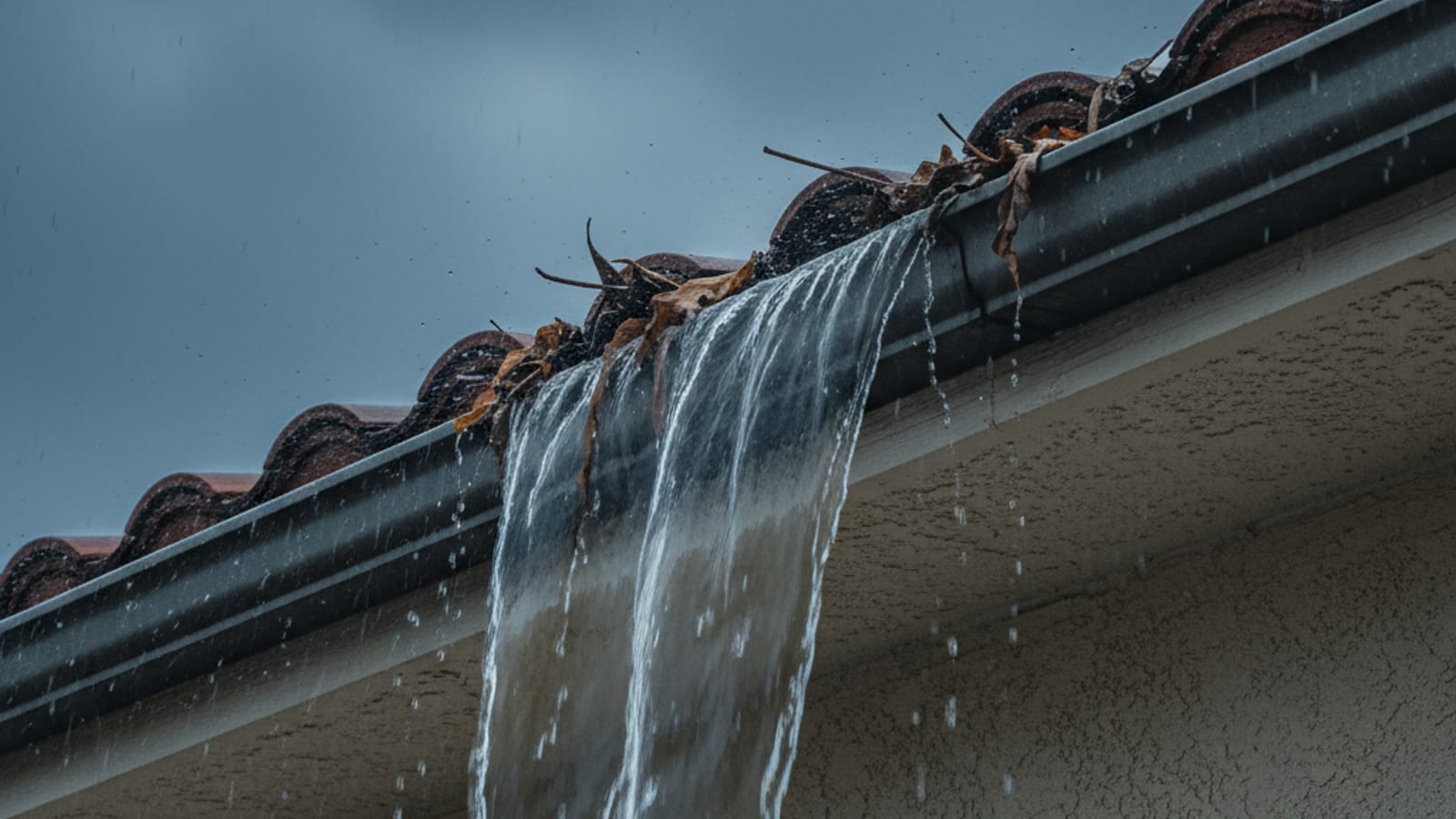
Gutters in San Diego feel like a non-issue until they aren’t. We don’t have the four-season leaf drop that makes gutter cleaning a cultural habit in the Midwest or Northeast. Most years we get four months of actual rain and some homeowners assume gutters take care of themselves.
Then the first real storm comes, water overflows, and the fascia starts rotting.
Here’s the schedule that actually works in San Diego’s climate, and why each visit matters.
Why gutters matter in a dry climate
The argument against San Diego gutter maintenance usually runs: “it barely rains, so who cares?” The issue isn’t the amount of rain. It’s what happens when it does fall.
A clogged gutter during a two-inch rainstorm (normal for a San Diego winter system) overflows 100+ gallons of water directly against the fascia, soffit, and stucco. That water:
- Soaks into fascia board (usually wood or wood-composite). Creates rot within 2–3 rain events.
- Backs up under roof tiles. Lifts flashing, sometimes pushes water into the roof deck.
- Runs down the exterior wall. Leaves vertical water stains and can infiltrate exterior paint or stucco.
- Pools at the foundation. Undermines slab edges and contributes to settling cracks over time.
None of this happens on a dry afternoon. It happens during the one weekend per year when the atmospheric river sits over you, and suddenly you’re looking at $3,000 in fascia repair because the gutter cost $180 to clean and nobody cleaned it.
What actually clogs San Diego gutters
Different problem than the east coast. Our common culprits:
- Jacaranda petals. Stunning trees. Purple petals by the thousand. They drop in late spring and early summer and they clog gutters quickly because they mat together.
- Eucalyptus leaves and bark. Dominant in much of central and North County. Leaves are long and curled; they cling.
- Pine needles. Mountain communities and parts of North County. Needles pack into screens and create impenetrable mats.
- Palm fronds and fiber. Coastal and South Bay. Palm “beard” fiber in gutters is a fire-starter in summer.
- Bougainvillea petals and leaves. Heavy drop in summer.
- Olive trees. Huge volume of small leaves plus oily olives that get stuck.
- Dust and dried-mud sediment. Accumulates through the dry season and forms a concrete-like base layer at the bottom of the gutter.
The seasonal schedule
Late fall (October–November): the main event
This is the one cleaning nobody should skip. Purpose: clear everything before the winter rains start.
- Full hand-clearing of all gutter runs.
- Downspouts flushed and verified.
- Valley and roof-gutter junction debris removed.
- Fascia and soffit visual inspection.
Homes under heavy tree canopy should consider a second winter cleaning in January or February if a significant storm system approaches.
Late spring (April–May): the jacaranda and bloom cleanup
Purpose: clear the spring bloom drop. Jacaranda, palm blossom, pollen, and general pollen-heavy drift.
- Lighter cleaning than fall but still hand-cleared.
- Flush downspouts (pollen cakes downspout elbows).
- Good time to inspect seams and look for hairline cracks that winter freeze-thaw may have caused.
Pre-fire-season (June): the safety check
Purpose: minimize fuel load in gutters before wildfire season peaks.
- Remove any dry leaf and debris load.
- Critical for homes in canyon communities, rural East County, and mountain areas.
- Insurance companies increasingly require this documented for wildfire coverage.
For canyon and rural homes, this becomes a non-negotiable. Ember intrusion into gutters full of dry debris is a leading cause of house loss in brush fires.
Post-event (anytime): the storm response
Purpose: clear unusual debris load from specific events.
- Santa Ana wind event drops massive leaf and branch load.
- Large tree trimming nearby.
- Roofing or construction work.
- Major storm that moved more debris than normal.
How often depending on what’s around your house
- Heavy tree canopy (pine, eucalyptus, oak overhanging roof): Quarterly.
- Moderate canopy (jacaranda, palm, some tree cover): Twice a year, with optional pre-fire-season check.
- Open-lot homes with minimal tree cover: Annually, late fall.
- Coastal homes with palm fiber and salt accumulation: Twice a year plus post-storm checks.
The DIY question
Single-story homes with accessible gutters can be DIY if you’re comfortable on a ladder. Two-story and up, just hire it out. Falls from home ladders are one of the most common ER visits in the United States.
If you DIY:
- Use a stable extension ladder with a ladder stabilizer (stand-off bar). Never rest the ladder rails on the gutter itself, as this can crush the gutter.
- Gloves. What’s in the gutter is not just leaves; it’s bird droppings, dead rodents sometimes, and decomposing organic matter.
- Eye protection. Splashing gutter slurry in your eye is memorable for the wrong reasons.
- Don’t overreach. Move the ladder three feet at a time.
- Have someone else home. Cell phone in your pocket. Tell them you’re on the roof.
Skip the DIY if you own a tile or slate roof. Walking those without proper pads damages them. Also skip if your roof pitch is over about 6:12. Pros have harnesses for a reason.
What we do on a gutter cleaning visit
Standard residential gutter service:
- Walk the perimeter. Note problem areas, clogged downspouts, sagging sections.
- Ladder-access each run. Hand-clear leaves and debris into a bucket.
- Bag debris. All leaves and sludge leave with us. No piles in your yard.
- Flush with hose. Verify every downspout flows clear. Snake any that don’t.
- Inspect fascia and soffit. Note (and photograph) any damage for your records.
- Report findings. If we see rot, seam separation, or sagging, you hear about it before we leave.
Single-story homes from $140. Two-story from $220. Three-story and steep two-story quoted on site. Bundle with window cleaning for a better rate.
Call (858) 925-5546 to get on the schedule. If it’s been more than 12 months and you haven’t thought about your gutters, it’s past time.