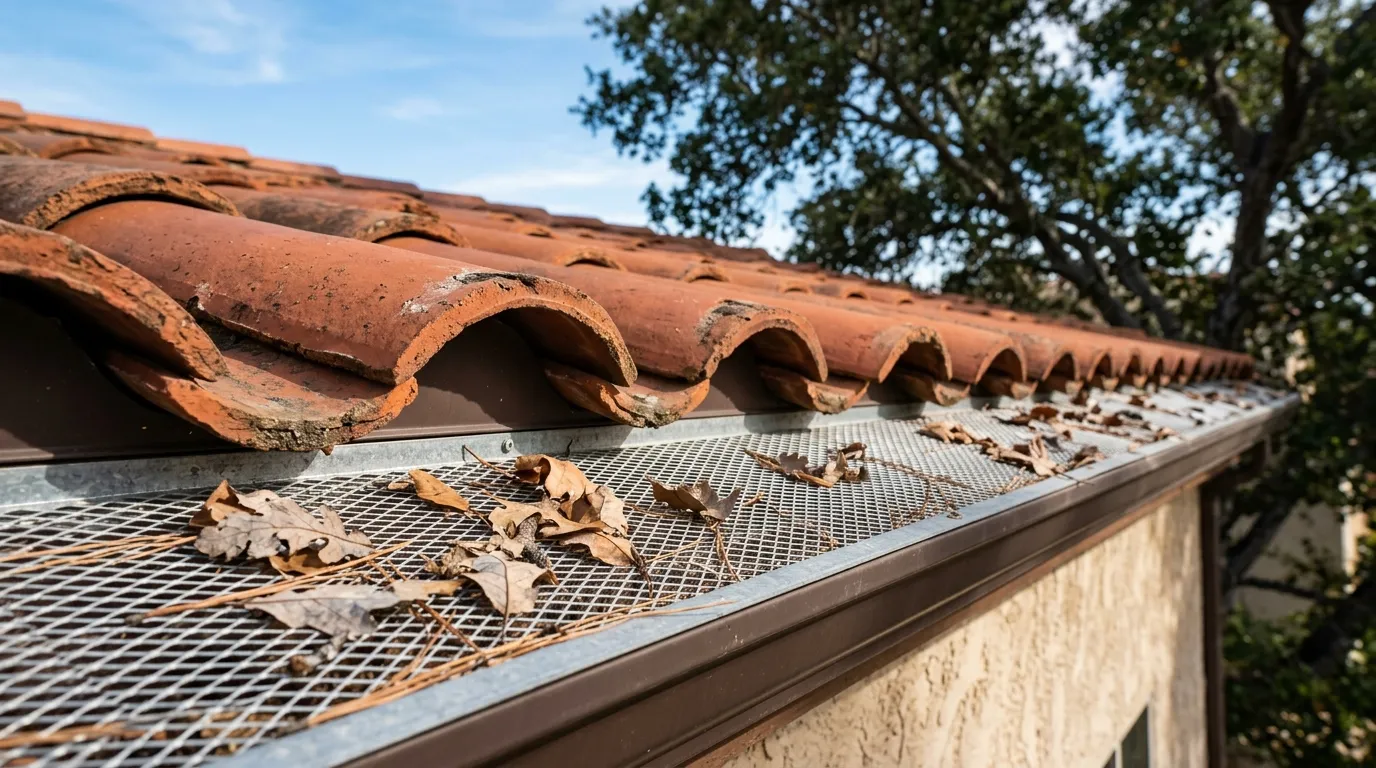
Gutter guards are worth it for San Diego homeowners with overhanging eucalyptus, jacaranda, or pine trees, especially on two-story homes where ladder access is a genuine safety concern. For everyone else, they reduce how often you clean but don’t eliminate it. Whether the math works depends on your tree situation, your roof height, and which product you buy.
Here’s the honest buying guide.
What gutter guards actually do (and don’t do)
The pitch for gutter guards is simple: cover the gutter, keep debris out, never clean again. The reality is more useful than that, and more honest.
A good gutter guard reduces the frequency of cleaning, slows clogging, and cuts down on the worst clogs that send water cascading over your fascia board. What it doesn’t do is seal your gutters against all organic debris forever.
Every type of guard eventually needs maintenance. What changes is the interval. A home with no guards may need cleaning twice a year. The same home with a quality micro-mesh guard might get by once every two years. That gap is where the value lives, and in San Diego it depends entirely on what trees are sitting over your roofline.
The San Diego debris problem
San Diego has unusually low annual rainfall, which means gutters aren’t flushing themselves. What they are doing is catching debris from some of the most prolific drop trees in Southern California.
Eucalyptus is the main offender. It sheds bark strips, seed pods, and long strappy leaves year-round, not just in fall. One mature eucalyptus overhanging a roofline can fill a gutter in a month. Jacaranda drops sticky flowers in late spring that compact into a dense mat and hold moisture against your fascia. Palm fronds and palm seeds pack tightly and don’t flush easily. Pine needles slide through wider-mesh guards without effort and then pack at the downspout.
Santa Ana conditions add another layer. Wind events blow fine debris and dust into gutters from trees and yards blocks away. After a bad Santa Ana, gutters that looked fine the week before can be half-full of grit and leaf fragments.
That combination, low rain plus constant debris plus periodic high-wind events, makes San Diego harder on gutters than many wetter climates where rainfall keeps things moving.
Types of gutter guards and how they perform here
Screen and mesh guards
Screen guards are the most common and the most affordable, running roughly $1 to $3 per linear foot installed. They block larger debris but let pine needles, jacaranda petals, and fine grit pass through or sit on top of the screen where they decompose and compact.
Standard mesh is a step up. It blocks medium debris but still struggles with the fine seed and flower debris common to San Diego yards. Useful if your trees are mostly broad-leaf deciduous and you just want to slow down cleaning intervals.
Micro-mesh guards
Micro-mesh is the product with the best real-world performance in debris-heavy environments. The openings are fine enough to block most seed and flower debris while still allowing water through. Installed cost runs roughly $15 to $25 per linear foot for quality products. That puts a typical San Diego single-story home at $600 to $1,200 installed, and a two-story at $1,000 to $2,000.
The trade-off is cost and the need for occasional surface cleaning. Fine debris like jacaranda flowers can sit on top of micro-mesh and eventually restrict flow. A leaf blower pass or a quick rinse once a year handles it. For a two-story home with eucalyptus trees, that maintenance is far easier and safer than descending into the gutter itself.
Foam and brush inserts
Foam inserts sit inside the gutter and let water seep through while theoretically catching debris on top. In practice, debris works its way into the foam, roots grow through it, and extraction becomes a messy job. Brush inserts have the same problem. Both types tend to make cleaning harder, not easier. We don’t recommend either for San Diego conditions.
Reverse-curve guards
Reverse-curve or surface tension guards rely on water clinging to a curved surface and flowing into a slot while debris flies off. They work reasonably well in lighter-debris environments. In heavy eucalyptus or jacaranda zones, the debris lands on the curve and doesn’t always clear. They also tend to direct water away from the gutter during heavy downpours, which is less of an issue in San Diego but still worth knowing.
When gutter guards make sense in San Diego
Gutter guards earn their cost when at least two of these conditions apply to your home.
The first is significant tree overhang. If you have one or more eucalyptus, jacaranda, or pine trees with canopy reaching your roofline, your gutters are working hard. Guards cut the cleaning frequency meaningfully.
The second is two-story or difficult roof access. Ladder work on a two-story home is where most gutter-cleaning injuries happen. If every cleaning visit requires a tall ladder on an uneven surface, a product that reduces those visits has real safety value, not just convenience value.
The third is a tight schedule. Homeowners who consistently forget or postpone gutter cleaning until something overflows benefit from a system that’s more forgiving of a delayed cleaning cycle.
Our gutter cleaning service handles the full inspection and cleaning process, and we flag access situations where guards would meaningfully reduce risk.
When gutter guards don’t make sense
Guards are harder to justify when your home has minimal tree coverage, a single-story roofline you can safely access, and the budget could be better spent on a regular maintenance plan that keeps gutters clean year-round for less upfront cost.
The math also changes if you’re leaning toward foam or brush inserts. Those products often create more work than they prevent and are almost never worth the investment in San Diego’s debris environment.
If your gutters are currently in poor shape, sagging, leaking at joints, or pulling away from the fascia, fix those problems first. Guards installed over failing gutters don’t solve the underlying problem and make it harder to access for repair.
The cost versus benefit breakdown
Here’s how the numbers typically work for a standard San Diego home.
A professional gutter cleaning runs roughly $150 to $300 for a single-story home and $200 to $400 for a two-story, depending on access and debris load. At two cleanings per year, that’s $300 to $600 annually for a single-story or $400 to $800 for a two-story. You can see the full cost picture in our gutter cleaning cost guide.
Micro-mesh guards installed on a typical single-story San Diego home run $600 to $1,200. If guards cut your cleaning cycle from twice a year to once every two years, the breakeven point is roughly three to four years. For a two-story home at $1,000 to $2,000 for guards, and where the safety and access reduction has real value, that breakeven case is stronger.
Standard screen guards at $1 to $3 per linear foot installed are a faster payback but a worse product for San Diego conditions. The savings on cleaning may be offset by the cleaning you still need, just with more obstacles in the way.
For the right combination of trees, roof height, and budget, quality micro-mesh guards pay for themselves. For lower-debris homes on a regular cleaning schedule, the maintenance plan approach often wins. Our post on maintenance plan vs. one-time cleaning walks through when each makes more sense.
What to expect after installation
Installing guards doesn’t mean setting and forgetting. The honest expectation for a San Diego home with quality micro-mesh guards is one light maintenance pass per year. This usually means a visual inspection, a leaf blower pass to clear the surface, and a downspout flush to confirm flow is unobstructed.
After Santa Ana events, a quick check is smart. High-wind debris loads can surface-pack even good micro-mesh. Catching it early means a two-minute fix rather than a partial clog that builds over months.
Some guard systems have warranties that require professional inspection to remain valid. Read the warranty terms before you buy.
A recurring seasonal check pairs naturally with pressure washing or window cleaning visits, so the inspection happens without a separate trip. Our gutter seasonal guide covers what to look for each season given San Diego’s specific bloom and debris calendar.
Who to call before you buy
Before you buy any gutter guard system, have someone clean and inspect your gutters first. Guards installed over debris are ineffective from day one, and the installation crew may not flag or fix what’s already in there.
Get a clear picture of what you’re working with: gutter condition, debris type, tree proximity, and roof access. That information tells you which product tier is worth the investment and which you can skip.
For a straight assessment and an upfront quote on cleaning, inspection, or a maintenance plan across San Diego County, call us at (858) 925-5546. We’ll tell you honestly whether your setup is a good candidate for guards or whether a regular schedule is the smarter spend.
You can also see how we structure ongoing gutter and exterior care at our San Diego window and exterior cleaning hub.
FAQ
Are gutter guards worth it in San Diego?
For homes with heavy tree overhang, especially eucalyptus, jacaranda, or pine, and for two-story homes where ladder access is a safety concern, quality micro-mesh guards are worth the investment. They reduce cleaning frequency meaningfully. For minimal-tree single-story homes, a regular cleaning schedule often costs less over time than guard installation.
What type of gutter guard works best in San Diego?
Micro-mesh guards perform best given San Diego’s debris mix of eucalyptus bark, jacaranda flowers, pine needles, and wind-blown grit. Screen and standard mesh guards let too much fine debris through. Foam and brush inserts tend to trap debris and roots, making future cleaning harder. Reverse-curve guards work in lighter-debris zones but struggle under heavy canopy.
Do gutter guards eliminate the need for cleaning?
No. Gutter guards reduce cleaning frequency, but don’t eliminate it. Micro-mesh surfaces can accumulate debris on top that eventually restricts flow. Downspouts still need periodic flushing. Most guard manufacturers recommend at least one inspection per year, and in high-debris San Diego yards, one annual maintenance pass is realistic.
How much do gutter guards cost in San Diego?
Installed costs vary by product type. Standard screen guards run roughly $1 to $3 per linear foot. Quality micro-mesh guards run $15 to $25 per linear foot installed. A typical single-story San Diego home might run $600 to $1,200 for micro-mesh. A two-story home with more linear footage runs $1,000 to $2,000. Always get a quote after a cleaning and inspection, not before.
Can I install gutter guards myself?
Some screen-type guards are sold as DIY kits. The installation itself isn’t highly technical, but getting on a ladder on a two-story home carries real risk, and debris-laden gutters need to be fully cleaned before installation for the guards to work. For two-story homes or anything involving significant height, professional installation is the safer choice.
What happens if I install gutter guards over dirty gutters?
Guards installed over existing debris trap that debris in place and restrict water flow faster. The debris continues breaking down and compacting, and when you eventually need to address it, the guards have to come off first. Always start with a full cleaning and downspout flush before any guard installation.