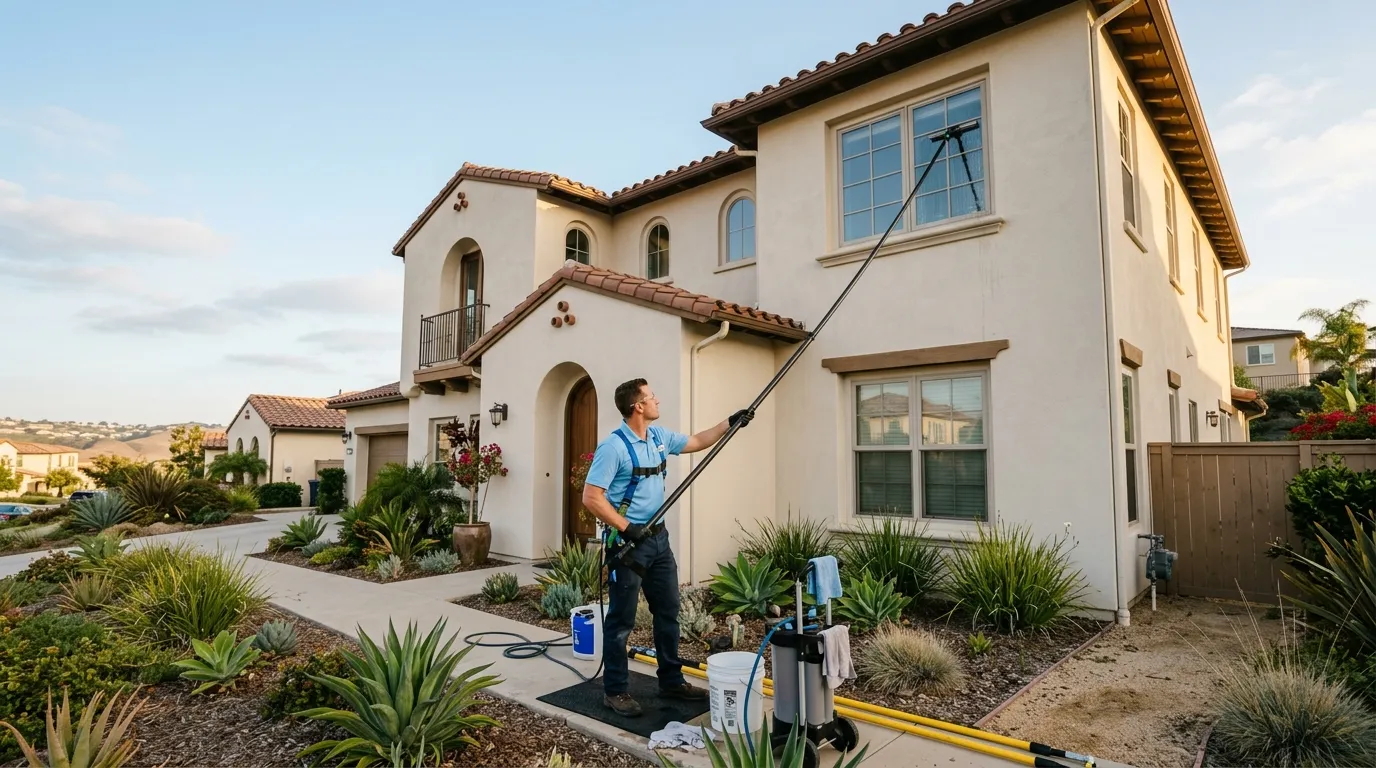
The safest way to clean second-story windows yourself is from the ground, using a water-fed extension pole or a long-handled squeegee. If the ground is flat, your windows are accessible, and you have the right tool, you never need to leave the ground at all. Ladders are an option when ground-based tools can’t reach, but they carry real fall risk and have a longer list of things that can go wrong.
Here’s how to approach the job by method, safest first.
Ground-based tools: the right starting point
A water-fed extension pole is the best DIY tool for second-story glass. The pole screws together to reach 20 to 30 feet. The brush head connects to your garden hose through the pole itself, delivering a stream of water while you scrub. You work with both feet on the ground the entire time.
The main limitation is control. You’re working at arm’s length plus the length of the pole, so precise squeegee strokes aren’t realistic. Most water-fed pole systems rely on a rinse-and-let-dry approach, which works well on newer glass but leaves water spots on already-spotted or etched surfaces.
Extension squeegees work on a similar principle. A telescoping handle extends to 12 to 18 feet, with a rubber squeegee blade on the end. You scrub with a separate extension brush, then squeegee. It takes practice to get clean horizontal or vertical strokes at height, but it keeps you off a ladder.
For streak-free results, finish with a clean rinse pass and let the glass air-dry on a mild, overcast day. Bright San Diego sun dries the glass too fast and leaves water lines. Marine layer mornings are actually decent for window cleaning because evaporation slows down.
What you need for the job
You don’t need much, but the right setup matters.
A telescoping extension pole rated for at least 24 feet gives you reach on most two-story California stucco homes, which run about 18 to 22 feet to the top of the upper-floor windows. A squeegee channel and blade that fits the pole end. A scrubbing sleeve or T-bar applicator for the soapy wash pass. A bucket with a mild dish soap or a dedicated glass cleaning solution.
For the water-fed pole approach, you’ll also need a garden hose long enough to reach from your spigot to the far corners of the house. Some systems filter the water before it reaches the brush, which helps with San Diego’s hard water and reduces spotting. Our post on water-fed pole window cleaning covers how those systems work and whether filtering is worth it for your setup.
Ladder safety rules if you go that route
Ladders are sometimes necessary. A bay window with no flat ground below it, a second-story window set back from the roofline, or a window that a pole can’t reach at the right angle. If you use a ladder, these rules are not optional.
Three points of contact at all times. Two feet and one hand, or two hands and one foot, stay on the ladder while you work. If you need both hands to scrub, you’ve extended too far from the ladder. Reposition the ladder instead.
Set the angle at 75 degrees. The old rule: one foot out from the wall for every four feet of height. A ladder set too steep tips backward. Too shallow and the feet slide.
Use ladder levelers on uneven ground. San Diego hillside lots, sloped driveways, and landscaped side yards almost never give you a flat base. Ladder levelers are inexpensive standout legs that screw into the feet and adjust independently. They’re not a luxury on hillside homes. They’re what keeps the ladder from walking sideways.
Never overreach. Your belt buckle stays between the rails. If you’re stretching sideways to reach a pane, get down and move the ladder. A two-minute repositioning takes far less time than a fall and recovery.
Keep your bucket on the ground. Hanging a bucket of soapy water on a ladder rung changes the ladder’s balance and gives you something to catch your foot on. Use a wrist lanyard for your squeegee, drop the bucket, rinse from the ground.
Avoid soft or damp soil. Ladder feet dig into soft yard soil and can shift mid-climb. Rain the night before or a recently watered lawn changes the ground. Either wait or use a ladder standoff that hooks over the wall rather than leaning the feet on the ground.
San Diego-specific conditions that matter
Most national guides talk about ladders on flat suburban lawns. San Diego has different terrain.
Two-story stucco homes on hillside lots in areas like La Mesa, El Cajon, and Rancho Penasquitos often have the backyard below street level, which means the house sits on an uneven grade and the second story is farther from the ground than it looks from the front. Ground-based poles are the right call for these situations.
Homes with tile roofs are common across San Diego County. Climbing onto a Spanish tile or concrete tile roof to access upper windows from above is a bad idea for two reasons. Tile roofs crack under foot traffic, and a cracked tile becomes a leak. And you’re now on a sloped, hard surface with no grip. This is the situation where the job should go to a professional crew that uses water-fed equipment and doesn’t need the roof at all.
Canyon-adjacent homes in Scripps Ranch, Mira Mesa, and Carmel Mountain Ranch sometimes have window access blocked by dense landscaping. Trees and shrubs that crowd the house make ladder placement difficult and sometimes impossible on one side. Work the accessible sides yourself and consider calling in a pro for the rest.
What to avoid
A few DIY approaches that come up in searches and consistently cause problems.
Pressure washers on glass. A pressure washer at full power can crack a window seal, force water into the frame, and strip caulking. If you’re using a pressure washer to clean glass, drop the pressure to its lowest setting and keep the nozzle at least two feet from the glass. Honestly, a bucket of soapy water and a brush does a better and safer job on glass.
Standing on the windowsill or roof edge. It happens. It’s how people fall. There’s no footing worth trusting on a painted wood windowsill or a tile roof edge.
A regular household stepladder. Step stools and A-frame ladders aren’t rated for exterior use at second-story height. An extension ladder rated for Type I (250 lbs) or Type IA (300 lbs) is the right tool.
Cleaning in wind. Wind moves a water-fed pole unpredictably at extension. On a ladder, a gust while you’re stretching is a real hazard. Santa Ana conditions in the fall are not the day for this job.
When the job needs a professional
Some situations are clear enough that it’s worth saying plainly: this is not a good DIY situation.
Homes where the only way to reach upper windows involves a ladder on a slope, near a pool, over a planting bed, or on a hillside property with significant grade change. Skylights on any roof. High-rise or three-story residential. Any exterior glass that requires standing on the roof itself. These are jobs for a crew with the right equipment, insurance, and experience working at height daily.
If your upper-floor glass has mineral spotting from hard water or salt haze, the cleaning also isn’t just a scrub job. Bonded mineral deposits need a specific treatment process, and attempting it yourself at extension-pole height with the wrong chemistry usually makes the glass worse. Our residential window cleaning service and high-rise window cleaning cover both situations.
We go through the full tradeoff between DIY and professional service in our post on DIY vs. professional window cleaning if you want to work through the decision before calling.
FAQ
What is the safest way to clean second-story windows?
From the ground, using a water-fed extension pole or a telescoping squeegee with a long handle. Both tools let you reach upper-floor glass without leaving the ground. If flat footing isn’t available or the glass is inaccessible from below, a ladder with proper setup and three-point contact is the next option.
How long of an extension pole do I need for a two-story house?
Most two-story homes in San Diego reach about 18 to 22 feet to the top of the upper-floor windows. A pole that extends to at least 24 feet gives you working clearance and a comfortable angle. Some poles reach 30 feet, which is more than enough for a standard two-story.
Can I use a pressure washer on second-story windows?
Not at full power. High-pressure water can crack window seals, force water into frames, and damage caulking. If you use a pressure washer at all, drop it to the lowest setting and keep the nozzle two feet from the glass. A scrub brush with soapy water and a rinse is safer and does a better job.
Is it safe to lean a ladder against a stucco or wood exterior?
Yes, with standoffs or ladder mitts. A bare ladder rail digs into stucco and can cause cracks. Rubber ladder mitts or a standoff bracket protect the surface and keep the ladder from slipping sideways along the wall. On stucco specifically, this matters.
Can I clean second-story windows on a San Diego hillside lot safely?
Hillside lots add real risk because the ground isn’t level and the effective height is greater than it looks from the street. Ground-based extension poles are strongly preferred here. If you need a ladder on a sloped surface, use adjustable levelers on the feet and have someone stable the base. If neither is possible, it’s a pro job.
When should I call a professional instead of cleaning upper windows myself?
When the only access requires a ladder on an uneven slope, near water, or over hard surfaces with no one to stabilize the base. When the glass has mineral spotting or salt etching that needs chemical treatment. When the job involves skylights or roof access. When the home is three stories or higher. Our window cleaning service in San Diego covers the county. Call us at (858) 925-5546 and we’ll tell you what the job involves before you book.